
- Climate
2025 review of climate misinformation and environmental coverage in the French media

For the first time, climate misinformation broadcast on television and radio has been quantified and qualified over an entire year. This is the subject of Science Feedback’s work in collaboration with the Observatory of Media on Ecology (OME).
13 cases of climate misinformation per week in 2025
For twelve months, we monitored climate-related news in all news programs (as defined by French media regulator ARCOM) on the 18 main television and radio channels in France, representing more than 5,000 hours of content. This monitoring is based on an automatic detection system developed in collaboration between Science Feedback, Data for Good, and QuotaClimat as part of the Climate Safeguards project. The AI model we have developed has a recall rate of over 80%, which means that we detect 80% of false or misleading information broadcast on climate issues.
The cases detected by the AI model were then characterized one by one by Science Feedback editors with the help of climate scientists, allowing us to include only proven false or misleading statements in our final count of misinformation cases.
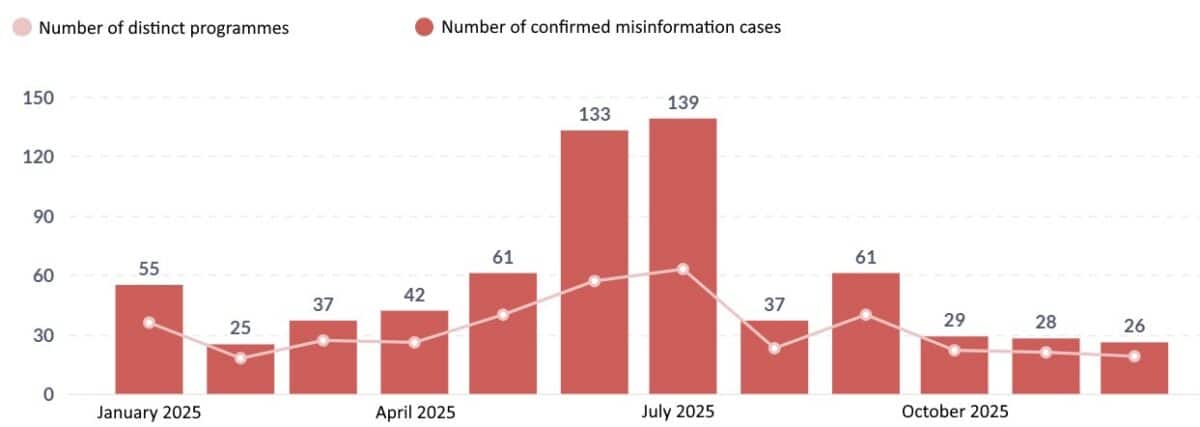
Over the course of 2025, we detected a total of 665 cases, an average of 13 cases per week.
Behind hundreds of cases, 19 dominant disinformation narratives
In order to understand the topics of all these cases of misinformation, we grouped them based on their semantic content. This also allows us to distinguish between isolated instances of misinformation (which are often inaccuracies or excessive generalizations) and statements that are often repeated and may be part of more proactive strategies intended to mislead the audience (hence the use of the term “disinformation” in this case).
The method consists of identifying repeated instances of misinformation that all feed into the same message, or “narrative”. The methodology we deployed relied on automated language analysis and manual verification to finalize groupings and assign each case to the most appropriate narrative. Our analysis reveals that 19 narratives, with at least eight occurrences, account for approximately 80% of all cases of misinformation identified.
For example, the most recurrent narrative, which grouped false or misleading claims that renewable energy causes electricity prices to skyrocket, was disseminated 125 times between January and August 2025.
The vast majority of these narratives were detected in the first half of 2025 and were then fueled by new cases throughout the year. All of the data collected, as well as the verifications associated with each of these narratives, are publicly available.
These groupings allow us to see that more than 90% of cases of misinformation linked to a narrative concern climate change mitigation solutions: 70% of cases deal with the energy sector, mostly renewable energies, 10% with mobility, and 9% with France’s role in global climate action.
On the other hand, claims denying the existence or human origin of climate change, although present among the 19 narratives, are now in the minority.
A decline in cases of climate misinformation at the end of 2025
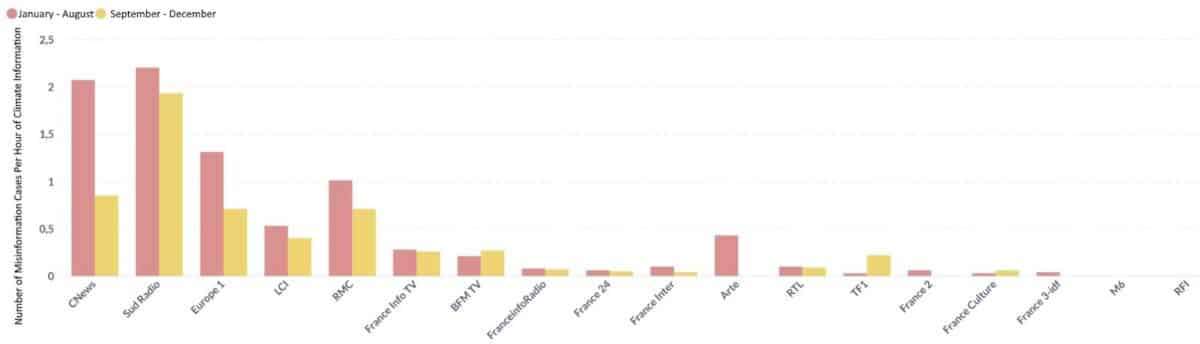
While the first eight months of 2025 have already been analyzed, this article reveals the preliminary results for the fourth quarter. There was a clear decrease in the number of cases of climate misinformation at the end of the year, both in absolute terms (Figure 1) and per hour of climate news coverage (Figure 2). The number of cases per hour of climate news fell significantly on CNEWS and Arte (where it reached zero), as it did on most channels, while it increased on TF1, for example.
“This trend can largely be explained by one key factor: the absence of any major debate on public environmental policy during this period. In other words, when climate issues are less prominent on the political and media agenda, opportunities to spread misleading narratives automatically decrease.”
Explains the OME in its 2025 Review (article in French)
Well-established narratives, with no renewal at the end of the year
Our analysis of the last four months of 2025 shows that cases of misinformation that can be linked to a narrative mainly fall under one of the 19 disinformation narratives identified during the first eight months of 2025. No new prominent narratives emerged during the last four months, confirming that climate disinformation relies less on innovation than on the repetition and consolidation of already well-established narratives.
Renewable energies, a prime target for disinformation
The most recurrent narratives continue to target variable renewable energies. The “top 3” most recurrent disinformation narratives remain unchanged: they include claims that fuel messages such as:
- variable renewable energies automatically cause electricity prices to skyrocket,
- receive allegedly huge public support, based on erroneous figures, and
- are inefficient due to their intermittency, or uncompetitive and unprofitable.
These narratives bring together claims that are most often based on fallacious reasoning, conflations between costs, prices, and investments, or inaccurate or unfounded figures.
Breakthrough of automotive narratives
In a context marked by the European Union’s backtracking on the ban on combustion engine vehicles by 2035, automotive narratives gained renewed visibility at the end of the year. Two narratives stood out in the last quarter of 2025:
- on the one hand, a narrative bringing together claims that electric cars pollute more than combustion engine or hybrid vehicles;
- on the other hand, a narrative bringing together claims that recent combustion engine cars or those powered by certain fuels do not pose an environmental problem.
These discourses illustrate the ability of climate misinformation to quickly reactivate itself based on political decisions or debates, by distorting or oversimplifying them.
A decline in climate science denial
Statements denying the existence or human origin of climate change were less numerous in the last quarter of 2025, with around eight cases recorded. However, the dominant narrative associated with these cases remains particularly worrying: it questions the anthropogenic origin of global warming, presenting it as uncertain or insignificant, even though these conclusions are well established scientifically.
Review of environmental coverage
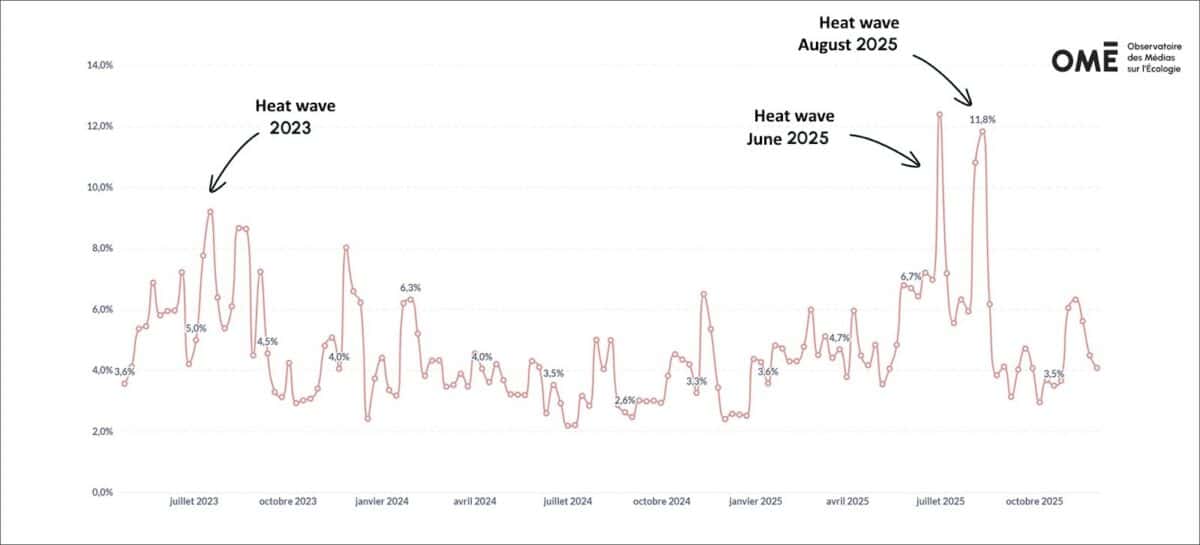
The Observatory found that 4.9% of news program airtime was devoted to environmental issues in 2025, an increase of 33% compared to 2024 (3.7%). This trend can be explained, among other things, by particularly extensive coverage of the two heatwaves, which accounted for 9% of airtime in June and 11% in August 2025.
In 2025, media coverage of environmental issues was very uneven depending on the sectors covered. The sectors emitting the most greenhouse gases and receiving the most coverage in news programs were, in descending order, agriculture, industry, and energy. However, transport, the leading greenhouse gas emitting sector in France, is not among the top three topic covered in the news.
To highlight this discrepancy between media coverage and the actual responsibility of sectors for national emissions, the Observatory compares the share of media coverage of environmental issues by sector with their weight in France’s greenhouse gas (GHG) emissions. We can see that agriculture is significantly overrepresented in media coverage compared to its relative weight in GHG emissions in France (35% of media coverage of environmental issues compared to 20% of sectoral GHG emissions), while the transport sector presents the opposite situation (12% of media coverage compared to 35% of GHG emissions).
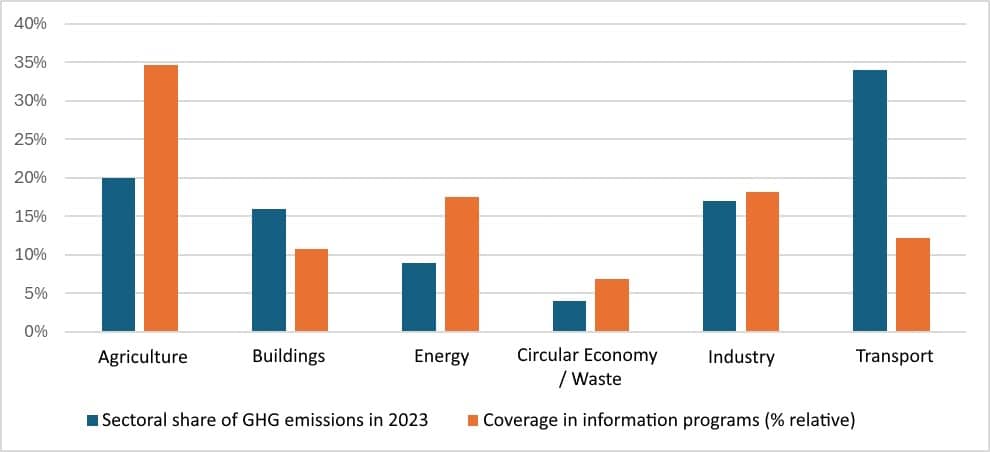
The limited coverage of environmental issues related to the transport sector, given the sector’s significance in terms of national emissions (35%), constitutes a vulnerability to misinformation. Two narratives of misinformation, revealed in October 2025, regularly mislead the public about the transport sector and its decarbonization: misinformation about the climate impact of electric cars (often exaggerated) and about the greenhouse gas emissions of combustion engine vehicles (often minimized). Both narratives gained traction in the last quarter of 2025 and were more prevalent during this period than on average during the first two quarters of the year.


