
- Energy
Are grid battery storage systems fire-prone? Early data suggests their fires are rare

From 2018 to 2024, the amount of battery storage installed on the world’s electric grids skyrocketed by around 3,000%.
There are good reasons why. Engineers think grid batteries are cornerstones of a low-emissions network. They solve many shortcomings of intermittent renewables like wind and solar – they absorb and store excess electricity, so they can deliver power when there’s no wind or sun, and they can stabilize the grid as a bonus.
But proposals to build new battery storage systems often face resistance. One of the largest concerns? Fire. You’ll find claims online that fires make grid batteries unreliable. And when grid batteries do catch fire, as happened in California earlier this year, you might see breathless news coverage. As more and more batteries are added to the grid, we’ll see more claims like this.
These claims might give the impression that any grid battery is an inferno waiting to happen. Are these fears justified? Grid battery fires are a real concern, but as we’ll show below, they’re probably quite uncommon.
Main Takeaways:
- Comprehensive data on grid battery fires is limited, but the existing data suggests that grid battery fires are probably very uncommon.
- In the past several years, the amount of battery storage on the world’s electric grids has dramatically increased. The existing data doesn’t indicate an increase in battery fires. This hints that grid batteries are becoming safer.
- Safety experts say that grid batteries have much lower fire risks than smaller lithium-ion batteries. Grid batteries are often required to meet strict safety standards, and they often come with safety features intended to prevent fires.
- It’s important to note that grid batteries are a very new technology. Many of us aren’t familiar with them yet. Therefore, when grid batteries do catch fire, they can catch a lot of attention that other fires might not.
How common are grid battery fires?
Since most grid batteries (also known as battery energy storage systems, or BESS) are just a few years old, there’s not much data on them. Science Feedback couldn’t find any peer-reviewed study with comprehensive global statistics on grid battery fires.
That said, the data we do have tells us that grid battery fires are quite rare. The Electric Power Research Institute (EPRI), a California-based nonprofit, maintains a global database of grid battery fires. According to EPRI’s data, only a tiny fraction of grid batteries experience fires.
Stephanie Shaw, Senior Technical Executive, Air Quality at EPRI, estimated to Science Feedback:
“BESS failures are rare. If they occur it is possible they can lead to thermal runaway and perhaps fire. However, only 0.3% of projects experienced a failure that led to a fire with potential safety concerns in 2024.”
EPRI’s database probably isn’t complete. Unhelpfully, battery manufacturers and grid operators usually don’t release this sort of information – EPRI compiles their database from news reports and other public documents.
But EPRI’s data gives us more reason to believe that batteries aren’t especially fire-prone. In the past several years, the amount of battery storage installed on the world’s grids has risen more than twenty-fold. We might expect to see the number of fires exponentially increase as well – but EPRI’s data doesn’t show that (Figure 1).

EPRI’s Shaw told Science Feedback:
“Over the past 6 years failure rates have dropped by 98+%. Failures per year have remained relatively constant during the same time frame that cumulative global BESS deployment has exponentially increased from 11 GWh in 2018 to over 300 GWh in 2024. In addition, continually-updated design features and controls, and well-trained first responders, have generally kept the impacts of rare failures small.”
There are unanswered questions – for example, we don’t have data showing what happens as batteries age (though as we’ll cover later, engineers have simulated this in the lab). And (as we’ll also cover later) some experts are unsatisfied even with this level of safety, and they’re working to make batteries safer. But relatively few batteries appear to catch fire.
Grid batteries can catch fire, but they’re designed with safety in mind
It’s worth understanding why, exactly, batteries can catch fire.
Essentially, a battery stores energy in chemical form, which is converted to electricity via controlled chemical reactions. This process is often a one-way street, but most grid batteries are lithium-ion batteries, which are very easily rechargeable. When we recharge a battery, we essentially reverse the reactions and allow ourselves to use it again.
Ordinarily, a lithium-ion battery is designed to discharge and recharge thousands of times without problems. However, if something goes wrong – for example, if the battery is damaged, if it overheats, or if it’s exposed to unsafe levels of current – the battery can enter an uncontrolled chemical reaction. Engineers call the ensuing process “thermal runaway”, and it’s why batteries can catch fire – grid batteries included.
Judy Jeevarajan, vice president and executive director of the Electrochemical Safety Research Institute at UL Research Institutes, told Science Feedback:
“Given the large size of the BESS, one should exercise caution especially if it is installed near or in habitable areas. The smoke and emissions from li-ion battery fires can be toxic and if the smoke and gases are confined, they can cause explosions as they are combustible in nature and have gases that can lead to explosions if the volume exceeds the lower flammability limit.”
How, then, do grid batteries compare with other types of lithium-ion batteries? Our world is filled with lithium-ion batteries. Your mobile phone almost certainly runs on a lithium-ion battery. If you have a power pack, an electric scooter, or an e-cigarette, you have a device with a lithium-ion battery. These are all batteries that are capable of thermal runaway.
And EV FireSafe, an Australian-government-funded company that studies lithium-ion battery fires, previously told Science Feedback:
“When we talk about lithium-ion battery fires, the problem is very, very firmly with these smaller, cheap, poor-quality devices”
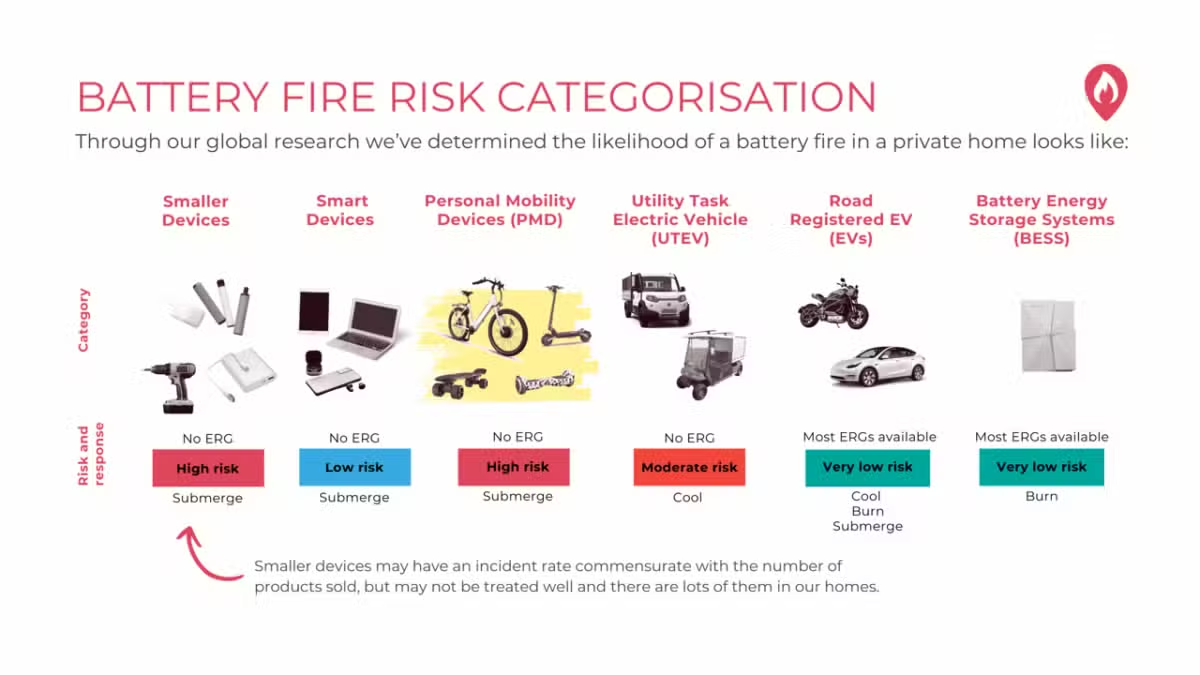
Why is this the case? For one, larger grid batteries often include safety features that are designed to prevent fires from erupting. They might contain failsafes that cut them off from the grid in the event of an electrical fault. They might include coolant to prevent overheating.
For another, unlike smaller batteries, grid batteries (as well as EV batteries) are subject to standards written to ensure that batteries are safe. Often, these standards include some of the above safety features. In many countries, someone who wants to build a grid battery must show that they are meeting these standards in order to gain approval.
These standards aren’t perfect – they vary from country to country, and some battery manufacturers don’t follow them[1]. An analysis of battery fires in South Korea indicated that fire risk increases when standards aren’t followed[2]. Jeevarajan from UL Research Institutes told Science Feedback:
“Several standards require that worst case events under off-nominal conditions be characterized but given the cost and time associated with such studies, these may not be commonly carried out for all the installation designs.”
But if that work is done and if a well-designed grid battery system does follow safety standards, then the fire risk drastically decreases.
Scientists and engineers are studying the safety risks of batteries
You’ll sometimes see opponents accuse battery projects of ‘experimenting’ on local residents, but the reality is that scientists and engineers extensively conduct these sorts of experiments in the lab. Safety testing is a critical part of designing new batteries[3].
Battery manufacturers will put their equipment through many of the same stresses they might face in the real world – including disasters. Researchers will intentionally blast batteries with high temperatures, buzz them with electrical faults, and puncture them and beat them up to simulate physical damage.
Another lab method is what engineers call large-scale fire testing – intentionally setting a battery on fire and watching it burn. This lets researchers understand, for example, what sorts of gases may get released if a certain battery catches fire.
Safety is also a consideration when engineers design new sorts of batteries. For example, most of the world’s lithium-ion batteries historically contain a mix of metals called lithium nickel-manganese-cobalt (NMC). In the last several years, however, many grid battery manufacturers have instead adopted another material called lithium iron phosphate (LFP). One reason for this is that LFP batteries are less prone to experiencing thermal runaway than batteries made with NMC cathodes[4].
Conclusion
If battery fires are rare and becoming rarer, then why do they get so much attention?
A large part of the answer is simply that grid-storage batteries are a rather new technology. They’ve only really entered the real world in the past several years. Many of us simply don’t know what they are and how they work.
So it’s easy for anything that happens to them to draw a lot of attention. Stephanie Shaw from EPRI told Science Feedback:
“It is important to keep these incidents in perspective; battery fires see a great deal more media attention than comparable fires with other infrastructure because the technology is new and not well-understood by the public.“
Furthermore, many first responders don’t fully understand how to tackle batteries. But as we build more grid batteries, and as we become more familiar with the technology, it’s reasonable to expect that they’ll become safer and they won’t seem as intimidating.
It’s the same reason you’ll see fire-related claims about battery-powered vehicles – we’ve written an insight about that here.
Lastly, it’s worth remembering that grid batteries are usually part of a larger transition away from fossil fuels and toward clean energy sources. One reason that people want to move away from fossil fuels is that fossil fuels harm both the environment and health.
This includes human health – a 2007 study found that gas electricity generation was responsible for 2.8 air-pollution-related deaths per terawatt-hour, biomass for 4.6, oil for 18.4, coal for 24.5, and lignite for 32.6 (a terawatt-hour is, on average, roughly how much electricity the US consumes in about 2 hours)[5]. The distant possibility of a battery fire may not seem so deadly by comparison.
References
- 1 – Edwards & Dobson (2024) Remarks on the Safety of Lithium-Ion Batteries for Large-Scale Battery Energy Storage Systems (BESS) in the UK. Fire Technology.
- 2 – Im & Chung (2023) Social construction of fire accidents in battery energy storage systems in Korea. Journal of Energy Storage.
- 3 – Jaugemont and Bardé (2023) A critical review of lithium-ion battery safety testing and standards. Applied Thermal Engineering.
- 4 – Jia et al. (2025) Advances and perspectives in fire safety of lithium-ion battery energy storage systems. eTransportation.
- 5 – Markandya & Wilkinson (2007) Electricity generation and health. The Lancet.