- Climate
2026’s El Niño may bring storms, heatwaves – and misinformation

Meteorologists have declared that El Niño is underway. You may have seen the dramatic headlines: that a “super El Niño” is coming, for example, or that El Niño may cause 2027 to be the hottest year on record.
Over the coming months, scientists expect, El Niño will bring intensified rainstorms, worsened droughts, or heightened temperatures to different parts of the world. We’re already starting to see this El Niño bring something else – misleading or false claims.
This sort of misinformation might use El Niño as a convenient scapegoat for climate change, shifting blame away from greenhouse gases like CO2. See, for example, claims that El Niño’s effects on the weather are proof that CO2 has no effect on the climate or that Europe’s recent record-breaking heatwave is due to El Niño, not climate change.
Claims like these fall into a well-worn category of climate falsehoods – ones that try to claim that modern-day climate change is ‘completely natural’ without the involvement of CO2. But they also miss the mark. When we see a severe El Niño event today, we’re really seeing the effects it has on an already-warming world.
Below, we’ll explain what causes El Niño, how it overlaps with human-caused climate change, and what can make it an easy target for misinformation.
Main Takeaways:
- El Niño is a weather phenomenon that happens every several years – it happens when a shift in wind patterns causes water to warm in the eastern Pacific.
- This affects weather around the world. El Niño can bring heatwaves, droughts, or storms, depending on the location – as we describe below. Global average air temperatures tend to spike in an El Niño year.
- The world cycles between El Niño and its counterpart La Niña. This cycle is not responsible for modern-day climate change. Instead, it’s happening atop the background of a warming world.
- Each El Niño and La Niña event lasts several years at most, while greenhouse gas emissions have been on a warming trend for decades. Climate scientists think this warming is exacerbating El Niño’s effects.
- Because El Niño tends to coincide with dramatic weather, it’s easy for misinformers to blame it for extreme weather, while downplaying the role of climate change. This falls into a category of false claims that climate change is entirely natural.
What is El Niño?
El Niño is caused by an interplay of wind and water near the equator in the Pacific Ocean.
Normally, the western edge of the tropical Pacific (the Asian side) has a warmer surface than its eastern edge (the South American side). This is because the equatorial trade winds, which blow from east to west, help push warm water west from South America to Asia. Cooler water then rises to the surface to replenish it.
Every few years, however, these trade winds weaken or change direction. When this happens, warmer surface water tends to stay along the eastern shore, thus warming the eastern Pacific. These warmer waters can last for a few months to a few years. This is the mark of an El Niño event (Figure 1).
The opposite of El Niño is La Niña – when these east-to-west trade winds speed up, which further cools the eastern Pacific.
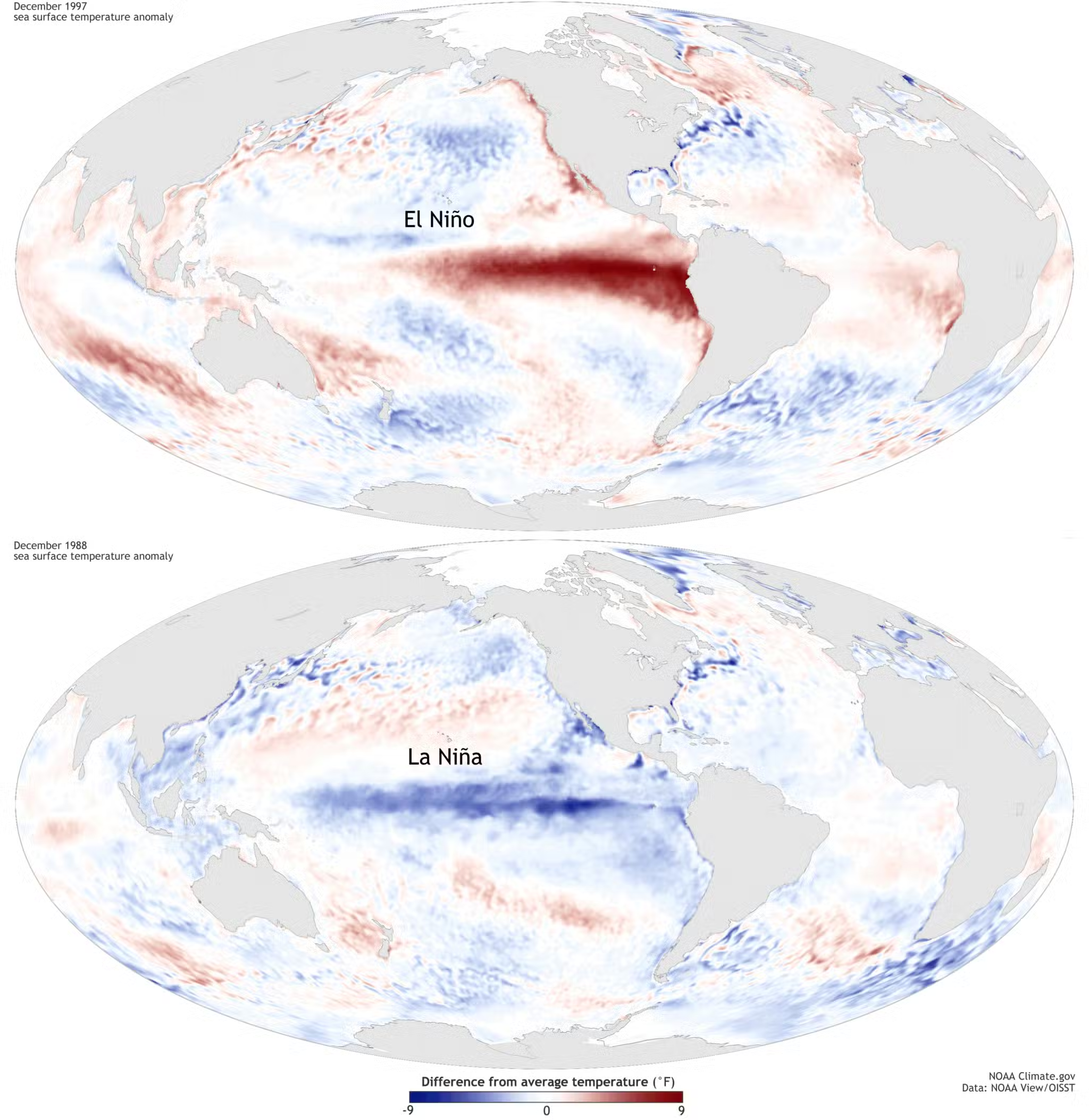
Because oceans transfer their heat to the atmosphere, what may seem like a local change in the water temperature can alter the weather not just in the Pacific, but far afield. El Niño and La Niña can alter the weather across the entire world.
In general, El Niño years tend to raise the average temperature of the entire globe.
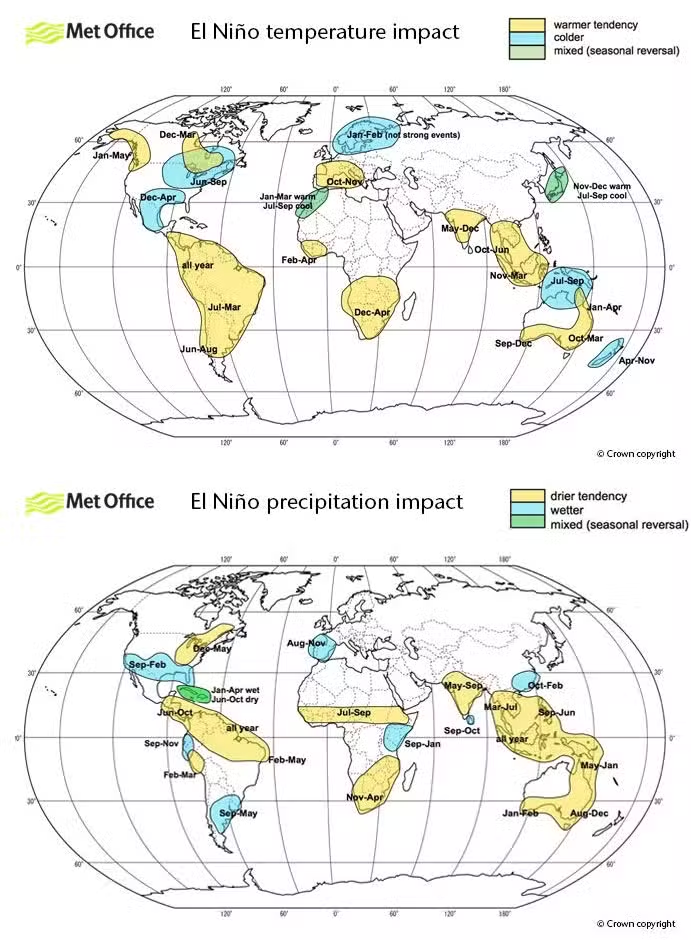
What, then, does this mean on a local scale? It’s hard to say with certainty. One El Niño can be more severe than the last, and its effects can vary from place to place and from season to season. That said, here is what tends to happen (see Figure 2):
- Western Europe, South America, Southern Africa, Australia, and South and Southeast Asia see warmer weather. Meanwhile, Northern Europe and much of North America can see cooler temperatures.
- Tropical regions in South America, Africa, and South and Southeast Asia may see less rainfall during an El Niño. In these regions, El Niño years have historically been associated with droughts.
- On the contrary, El Niño can actually lead to increased rainfall in some regions, such as North America and Western Europe.
- There’s evidence that El Niño events lead to coral bleaching events.
La Niña usually, though not always, has the opposite effects to El Niño. La Niña tends to cool global temperatures.
The world continually swings back and forth between El Niño and La Niña, with neutral years in between. You may see climate scientists and meteorologists call this cycle the El Niño–Southern Oscillation (ENSO).
This cycle is not regular. For one, some El Niños last longer than others, and the time between El Niños and La Niñas can vary by years.
For another, some El Niño or La Niña events are stronger than others (Figure 3). The more that an El Niño or La Niña shifts the Pacific Ocean’s water temperatures, the stronger its effects tend to be on the rest of the world’s weather. Especially strong El Niños are sometimes called “super El Niños”.
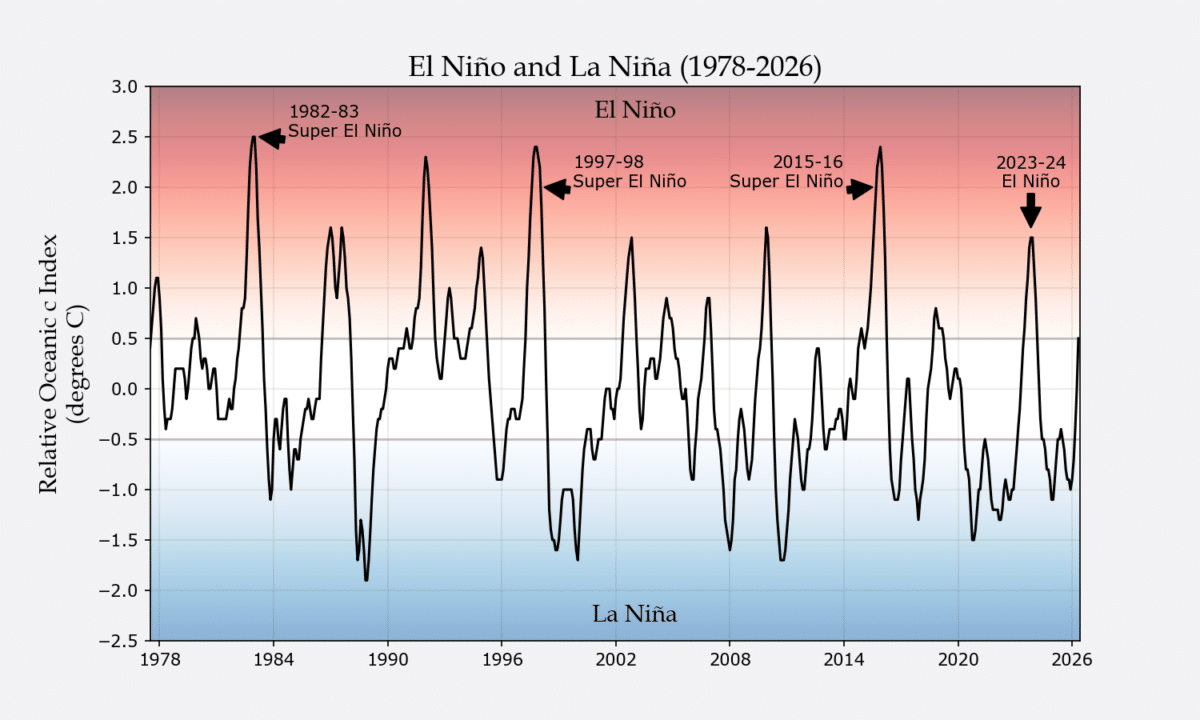
Some scientists predict that the 2026 El Niño will be a “super El Niño”, like the 2015-16 event.
Is climate change affecting El Niño?
Climate scientists know that today’s El Niño events are unfolding atop the background of greenhouse-gas-caused climate change. For example, in a warming world, a strong El Niño can bring strong heatwaves and set record high temperatures.
Crucially, this doesn’t mean that El Niño alone is responsible for this extreme weather. We can clearly see this by looking at global average temperatures during some recent El Niño events:
- The 2015-16 Super El Niño coincided with the warmest years recorded until that date[1]. Although this El Niño event was unusually strong, climate scientists say these warm temperatures are “unlikely” to have occurred naturally without climate change[2].
- The 2023-24 El Niño, likewise, saw even warmer years – 2024 in particular remains the warmest year recorded as of this writing – even though the later El Niño was the weaker of the two. Climate scientists think that El Niño alone can’t account for this heat[3]. One estimate found “a key role for human-induced climate change, with a small contribution from El Niño”[4].
- In fact, the past 11 years, from 2015 to 2025, have all been the 11 hottest on record – and that includes the 2020-23 La Niña, which you might expect to bring cooler temperatures.
- Remarkably, those 11 hottest years don’t include the strong El Niños of 1982-83 or 1997-98, although these “super El Niños” were stronger than 2023-24 and were on par with 2015-16 as the strongest in recent history (see Figure 3 above).
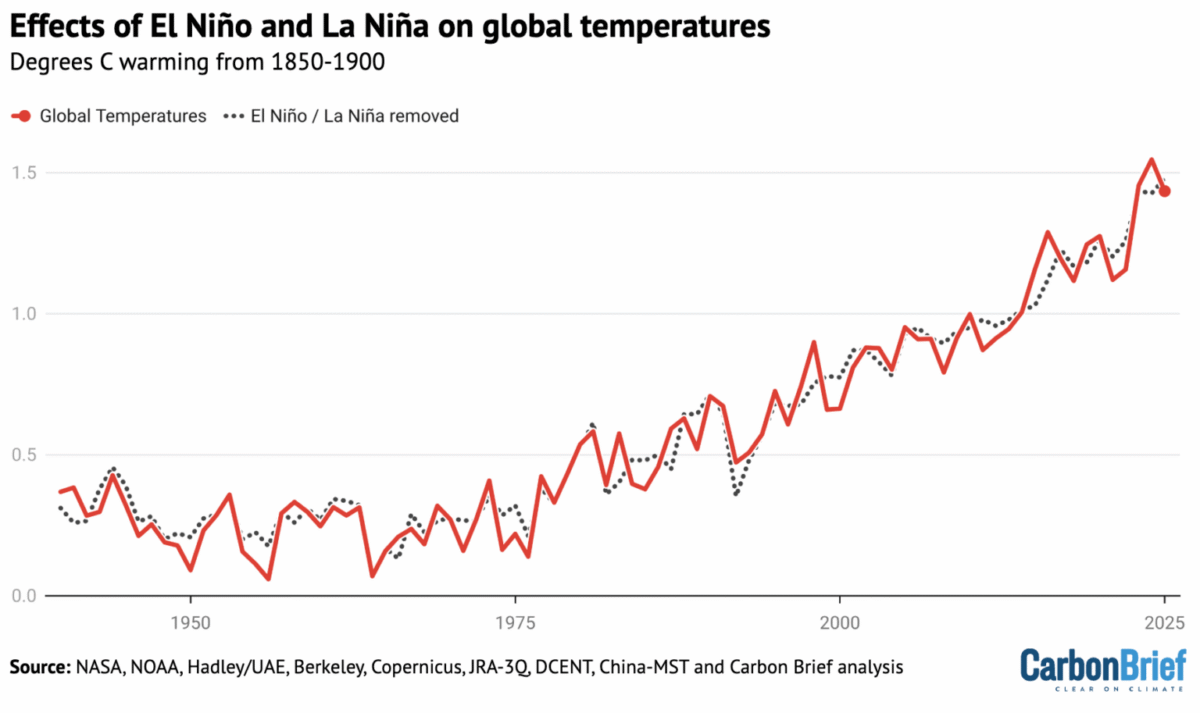
These examples show that El Niño is not responsible for broader climate change. Indeed, we’d still see record global temperatures even if we had no El Niño and La Niña (Figure 4).
There’s also some evidence that climate change is increasing the speed at which the world swings between El Niño and La Niña, although here again the fact that ENSO is so variable means that it’s not conclusive evidence[2,5].
The IPCC says there is “medium confidence” that the frequency of high-intensity El Niño and La Niña events has increased since the Industrial Revolution[2,5], and a 2023 study found that extreme El Niños became more common after 1960[6].
Furthermore, some climate scientists think that “extreme” El Niño and La Niña events – ones that bring particularly severe storms and temperature rises – may become more frequent as the climate continues to warm[2].
‘Natural cycles’ do not cause climate change
Both ENSO and global warming are phenomena that alter weather patterns around the world. Figure 4, however, highlights the key difference between the two:
- El Niño and La Niña form a back-and-forth cycle. They can intensify heat or storms when they do happen, but the effects of an El Niño or La Niña will only last for months or several years at most.
- Climate change is a longer-term phenomenon. Earth’s average temperatures have steadily risen for the past several decades. This leads to more severe weather in the long term.
Because extreme heat and extreme storms can and do happen during an El Niño event, misinformers can take advantage of this and falsely claim that El Niño is the sole cause. By doing so, they can acknowledge that the climate is changing or that extreme weather is happening, but deny that humans are responsible.
Misinformation trying to shift blame from greenhouse gases to ENSO is not a new phenomenon (we’ve reviewed similar claims in 2016 and 2022), but as a new El Niño begins, we’re likely to see far more misinformation of this kind in the year ahead – especially if this is a “super El Niño” as some meteorologists predict.
This June 2026 article from Climate Change Dispatch (a website with a long history of spreading climate-related falsehoods) and the German-language video it links are good examples of the tactics this sort of misinformation can use:
- Blaming El Niño for extreme weather events like Europe’s June heatwave, trying to shift responsibility away from climate change.
- In reality, climate scientists have shown that the high temperatures Western Europe experienced during its recent heatwave would have been impossible without climate change.
- Describing El Niño as “a completely natural phenomenon known for centuries” and attributing to it “the collapse of the Moche culture in the 8th century” to give the impression that these conditions are normal.
- In reality, as we’ve seen, climate change exacerbates El Niño’s effects. While some archaeologists believe that ENSO contributed to the collapse of ancient Peru’s Moche culture, other factors were likely involved.
- Portraying the “CO2 theory” as “alarmism” to make it seem like a controversial position, while painting those who have shown CO2 is responsible for climate change as “alarmists” to discredit their views.
- In reality, up to 99% of climate scientists agree that greenhouse gases like CO2 are responsible for climate change.
We know what causes climate change: greenhouse gas emissions, largely from burning fossil fuels[7]. The supporting evidence is vast, has collected for many decades, and continues to grow. There is no uncertainty about this cause.
Claims otherwise do not represent climate science or the vast majority of climate scientists. Instead, they serve to cast doubt on climate science and undermine it. This can benefit, for example, the producers of climate-change-causing fossil fuels – who are known supporters of climate change misinformation.
References
- 1 – Hu & Fedorov (2017) The extreme El Niño of 2015–2016 and the end of global warming hiatus. Geophysical Research Letters.
- 2 – IPCC (2021) Weather and Climate Extreme Events in a Changing Climate. In: Climate Change 2021: The Physical Science Basis.
- 3 – Minobe et al. (2025) Global and regional drivers for exceptional climate extremes in 2023-2024: beyond the new normal. npj Climate and Atmospheric Science.
- 4 – Min S.K. (2024) Human influence can explain the widespread exceptional warmth in 2023. Communications Earth & Environment.
- 5 – IPCC (2021) Changing State of the Climate System. In: Climate Change 2021: The Physical Science Basis.
- 6 – Cai et al. (2023) Anthropogenic impacts on twentieth-century ENSO variability changes. Nature Reviews Earth & Environment.
- 7 – IPCC (2022) Sixth Assessment Report.