
- Health
Doctor misleads with post claiming ivermectin works against hantavirus
Key takeaway
Hantavirus infection is primarily spread by exposure to excreta from wild rodents, although rare cases of human-to-human transmission by one hantavirus have been reported. The infection produces flu-like symptoms, including fever, chills, and muscle aches. Severe disease can lead to breathing difficulties and internal bleeding. There is no specific medication that can be used to treat hantavirus infection and treatment is limited to supportive care that alleviates symptoms.
Reviewed content
Verdict:
Claim:
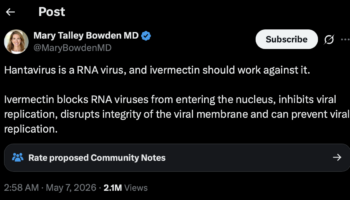
Ivermectin “should work” against hantavirus because it blocks “RNA viruses from entering the nucleus [and] inhibits viral replication”
Verdict detail
Misleading:
Some lab studies indicate that ivermectin can inhibit viral replication by blocking viral proteins from entering the host cell’s nucleus. However, this wouldn’t affect hantavirus whose replication doesn’t involve the nucleus.
Inadequate support:
There’s a lack of scientific studies investigating the effect of ivermectin on hantavirus, making it impossible to say for sure if and how it will affect the virus.
Full Claim
“Hantavirus is a RNA virus, and ivermectin should work against it. Ivermectin blocks RNA viruses from entering the nucleus, inhibits viral replication, disrupts integrity of the viral membrane and can prevent viral replication.”
Review
The hantavirus outbreak on the cruise ship MV Hondius has triggered a slew of reactions on social media, with some drawing parallels to the early days of the COVID-19 pandemic. Social media accounts that spread misinformation about COVID-19 and vaccines have also kicked into high gear, rehashing similar themes.
Among them are otolaryngologist Mary Talley Bowden. On 7 May 2026, she posted on X claiming that “Hantavirus is a RNA virus, and ivermectin should work against it”, adding “Ivermectin blocks RNA viruses from entering the nucleus”. The post received 1.6 million views in less than a day. It was subsequently shared by former U.S. Representative Marjorie Taylor Greene.
For context, Bowden was reprimanded by the Texas Medical Board in December 2025 for prescribing ivermectin to a patient at a hospital where she didn’t have privileges. She also previously claimed vaccines against the respiratory syncytial virus (RSV) were “[a]ll risk and no benefit”, which is unsubstantiated. In fact, the evidence indicates that the vaccine reduces the risk of disease and hospitalization in young children and the elderly, two groups at higher risk from RSV complications and death.
Ivermectin has become a “miracle drug” pushed by various groups that initially promoted it as a COVID-19 treatment, even though large-scale clinical trials didn’t find that the drug was effective, as Science Feedback explained in a previous review. While the pandemic is behind us, the hype around ivermectin isn’t. In fact, it’s grown, with some groups now touting it as a cancer cure, even though clinical evidence doesn’t back up this claim.
The current scientific evidence doesn’t support Bowden’s claim that ivermectin can act on hantavirus by blocking viral entry into the nucleus. We explain below.
As randomized clinical trials are the gold standard for determining the effectiveness and safety of a drug, we first turned to the website ClinicalTrials.gov, an online database of clinical research studies operated by the United States National Library of Medicine. But our search for clinical trials testing ivermectin on hantavirus infection turned up no results.
Next, we took a look at whether published studies backed Bowden’s assumption about ivermectin’s effect on RNA viruses. Here, we found that she drew on generalizations about RNA viruses that don’t apply to the hantavirus.
It’s true that ivermectin has been shown in laboratory studies to block the transport of certain viral proteins into the cell nucleus (the cell compartment that carries our DNA), thereby interfering with viral replication[1,2].

It’s also true that certain RNA viruses rely on the host cell nucleus to replicate, two well-known examples being the influenza virus and the human immunodeficiency virus. In spite of what Bowden implied in her post, the involvement of the host cell’s nucleus in viral replication is not exclusive to RNA viruses: for example, human adenoviruses, which are DNA viruses, also rely on the cell nucleus for viral replication[3].
The key problem with Bowden’s claim is that hantavirus replication doesn’t involve the nucleus and is confined to the cytoplasm of the cell—outside the nucleus. Therefore, ivermectin’s ability to interfere with viral infection by blocking the nuclear entry of viral proteins is unlikely to affect hantavirus replication.
That said, we can’t rule out the possibility that ivermectin acts on hantavirus through other mechanisms. Indeed, a single drug can affect a pathogen through more than one biological pathway. But the evidence we do have indicates that the mechanism proposed in Bowden’s post is unlikely to affect hantavirus replication as claimed.
In any event, the evidence available doesn’t support the use of ivermectin for preventing or treating hantavirus. Apart from the absence of a proven benefit, using ivermectin is not without risk. Ivermectin poisoning cases, which rose during the COVID-19 pandemic, are a testament to that. At the moment, treatment for hantavirus infection is mainly limited to alleviating symptoms as there’s currently no specific treatment or vaccine for the infection itself.
References:
- Yang et al. (2020) The broad spectrum antiviral ivermectin targets the host nuclear transport importin α/β1 heterodimer. Antiviral Research.
- Wagstaff et al. (2012) Ivermectin is a specific inhibitor of importin α/β-mediated nuclear import able to inhibit replication of HIV-1 and dengue virus. Biochemical Journal.
- King et al. (2020) Inhibition of Human Adenovirus Replication by the Importin α/β1 Nuclear Import Inhibitor Ivermectin. Journal of Virology.