
- Health
Scientific evidence doesn’t back the hype over colostrum supplements

Colostrum is the earliest milk produced by mammals, including humans, in the first few days after giving birth. It’s packed with a variety of vitamins, proteins and other nutrients to help a newborn’s health get off to a good start—small wonder that it’s been given the name “liquid gold”.
This glowing reputation has attracted many people who hope to reap the same benefits, spawning a market for colostrum supplements that are promoted on social media.
Perhaps one of the most prominent advertisements for colostrum is this TikTok video from November 2025, which features American socialite Kourtney Kardashian Barker promoting her “Lemme Colostrum” supplement. In the video, an immaculately dressed Kardashian Barker declares that colostrum “improved my gut health” and “boosted my immune system”.
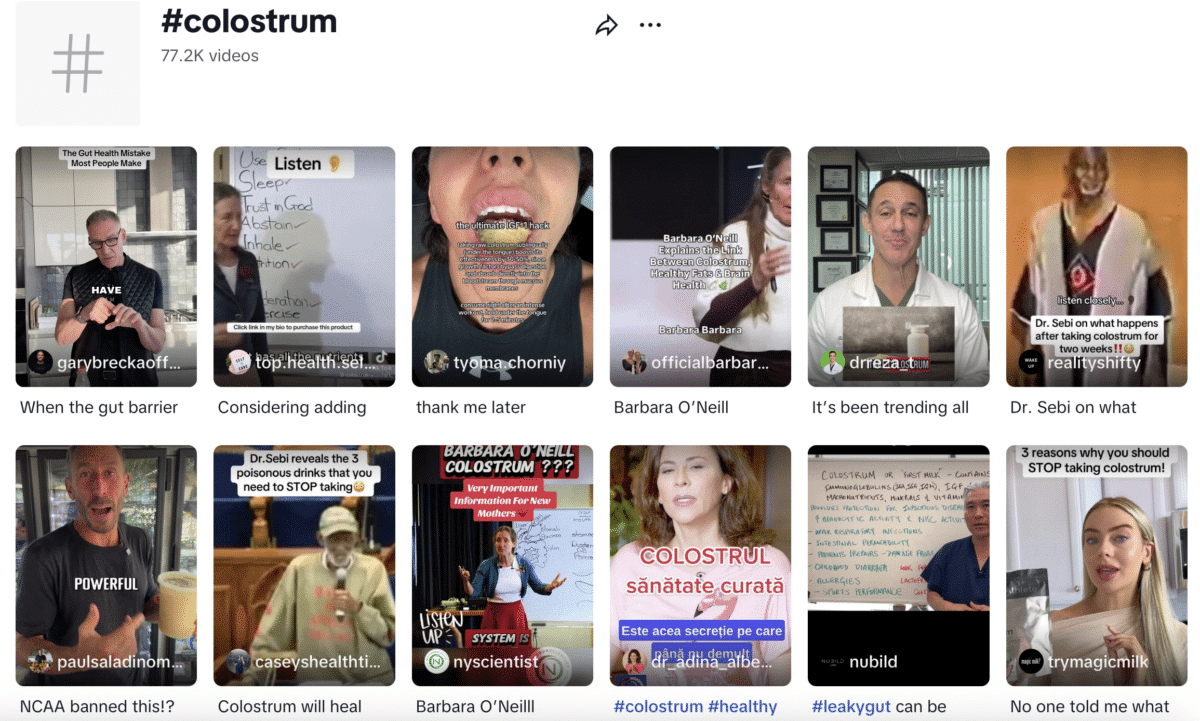
Similar claims have proliferated across social media platforms; for instance, there are more than 77,000 videos carrying the hashtag #colostrum on TikTok. And the claims have spread in multiple languages, including French, Polish, and Spanish.
However, the current scientific evidence on colostrum’s effects in adults doesn’t live up to the online hype. We explain in this Insight article.
great for babies, but effects in adults remain unclear
Scientific evidence has clearly established colostrum’s benefits in infants, but it doesn’t mean that the same effects will happen in adults.
Rachel Woods, a lecturer at the University of Lincoln who specializes in nutrition and the human microbiome, highlighted important differences between babies and adults that impact colostrum’s effects in this article for The Conversation.
For instance, babies and adults don’t share the same nutritional needs. Moreover, unlike adults, the immune system of a baby isn’t fully developed. For these reasons, colostrum will have a much greater impact on a baby’s health. In a healthy adult who has a fully developed digestive system and mature immune system, however, colostrum’s effects are unlikely to be especially meaningful.
“What is essential for a baby is not automatically useful or necessary for an adult body,” Woods wrote.
Some of the conversation around colostrum’s gut benefits revolves around its ability to promote the growth of beneficial gut bacteria in infants. But this effect is unlikely to be seen in an adult whose gut microbiome is already well-established, in contrast to an infant’s which is undeveloped.
Federica Amati, a nutritionist at Imperial College London and head nutritionist at personalized nutrition company ZOE, told National Geographic: “If you give an infant gut colostrum, it will respond, because the biome and immune system are still forming”. But the older someone grows, the more difficult it becomes to dislodge the microbes that have already taken up residence in the gut.
Furthermore, it’s possible to cultivate a healthy gut microbiome without using colostrum. For example, Woods pointed out that naturally occurring prebiotic fibers in foods like onion, leek, and garlic feed beneficial bacteria in the gut. In fact, there are many ways to maintain and build a healthy gut microbiome that don’t require people to spend money on supplements, like consuming more fiber and being physically active.
Apart from its ability to cultivate healthy gut bacteria, there have also been some studies which reported that consuming bovine colostrum could reduce intestinal permeability—a condition colloquially known as “leaky gut” that’s seen in certain inflammatory diseases of the gastrointestinal tract like Crohn’s. These findings suggest that colostrum might be helpful in mitigating inflammation in the gut.
However, Woods cautioned that “these studies involved only a small number of participants in specific contexts, not healthy adults in everyday life”. She highlighted the need for “larger, well-designed clinical trials” before making any conclusions about colostrum’s effect in the adult gut.
In addition to cultivating healthy gut bacteria, colostrum increases a newborn’s protection against infection because it carries antibodies from the mother. This could be the basis of claims that colostrum supplements boost immunity. But it’s unclear how much of an effect this borrowed immunity will have for a healthy adult.
Furthermore, colostrum supplements are typically derived from cows, and the amount of antibodies in bovine colostrum is likely to vary between products, said Amati. Moreover, supplements don’t have to be tested, meaning it’s difficult to determine whether all colostrum products will contain the same amount of antibodies.
And finally, as explained above, a healthy adult already has a fully functioning immune system capable of producing its own antibodies against infection. It’s unclear whether the amount of antibodies in consumed bovine colostrum will make a meaningful difference to an adult’s immunity.
Beware of claims that misrepresent studies
In an attempt to bolster their credibility, some social media posts cite published studies that they claim establishes colostrum’s benefits, but it’s important to take these references with a grain of salt.
An example can be seen in this Instagram reel by carnivore diet influencer Paul Saladino which was posted in February 2026. However, his claims overstate the findings of these published studies, which contain important caveats that aren’t mentioned in his post.
For example, five of the six studies cited (here, here, here, here, and here) were performed in athletes or groups which engaged in regular physical training, so the results cannot be generalized to the broader population.
Furthermore, Saladino claimed that colostrum is more effective than the flu vaccine at preventing flu, but the study he cited to support this claim is flawed in several ways.
That study aimed to examine how often healthy people and those with high-risk cardiovascular conditions developed flu and how long their symptoms lasted, depending on whether they took colostrum or the flu vaccine, or a combination of both. The researchers’ conclusions were that “Colostrum, both in healthy subjects and high-risk cardiovascular patients, is at least 3 times more effective than vaccination to prevent flu and is very cost-effective”.
However, the researchers didn’t describe how they established that a person had the flu or just an infection resembling the flu, like the common cold. The methods stated that “all subjects were reevaluated by phone or personal contact every 2 weeks with a questionnaire”, which suggests that the study’s results were based on self-reports by participants, rather than more objective data collection methods like clinical testing for flu.
Self-reporting introduces a significant risk of bias, especially when researchers don’t take steps to independently verify participants’ answers.
The study also misrepresented some of the references it cited. For instance, it claimed that “[t]he use of vaccination in subjects with severe immunologic and inflammatory disorders can be also questioned because most vaccines may not be safe […] concerns have also been raised about flu vaccination in pregnancy”.
But the reference cited here (in Spanish) makes no mention about safety concerns related to the flu vaccine. On the contrary, it expressed concern over the low uptake of the flu vaccine in pregnant women, a group at a higher risk of flu-related complications.
The study also claimed “The efficacy of flu vaccination and its cost-effectiveness is probably questionable because of the possible presence of unknown and known side effects. A relation between the incidence of intussusception associated with the first dose of vaccine in infants was recently shown”.
But the studies cited here don’t support this assertion. For instance, the citation related to intussusception wasn’t about the flu vaccine, but a rotavirus vaccine. One reference had to do with potential genetic determinants of vaccine responders and non-responders, but did not mention side effects.
In short, the study doesn’t credibly establish colostrum’s effectiveness at preventing flu and it repeatedly referenced other publications in an inaccurate manner to question the flu vaccine’s safety, which has been demonstrated in other studies. These red flags raise questions about the credibility of its claims, and that of Saladino’s.
Pay attention to the language used to promote supplements
Since dietary supplements don’t need to undergo testing or clinical trials, there are typically regulations around the way they can be advertised to prevent consumers from being misled.
For example, the U.S. Food and Drug Administration prohibits marketers from claiming that a dietary supplement is intended to “diagnose, treat, cure or prevent any disease”; such language is only permitted for drugs, which are subjected to much more stringent testing and oversight.
As such, we tend to see dietary supplements advertised in specific ways, like invoking structure/function claims:
‘Structure/function claims may describe the role of a nutrient or dietary ingredient intended to affect the normal structure or function of the human body, for example, “calcium builds strong bones.” In addition, they may characterize the means by which a nutrient or dietary ingredient acts to maintain such structure or function, for example, “fiber maintains bowel regularity,” or “antioxidants maintain cell integrity.”’
Another way that supplements are advertised is by using vague terms that lack a scientifically agreed-upon definition, like “improves well-being”, or terms that hint at scientific credibility, like “clinically studied”.
The problem is that there isn’t a scientific way to measure well-being, and “clinically studied” doesn’t mean the same thing as “clinically proven”.
While “clinically studied” means that an ingredient was tested in a scientific study, “it does not indicate whether the results were positive, significant or relevant to human health”, Woods pointed out. But the two terms are easily confused and misinterpreted by consumers.
Another rhetorical device that some influencers have used in relation to colostrum is to invoke the fact that the U.S. National Collegiate Athletic Association (NCAA) banned it, as seen here and here, which supposedly demonstrates its potency. Claims like this can invoke the idea of the “forbidden fruit”, making the banned thing more attractive to others.
It’s true that the NCAA has banned student athletes from taking colostrum. This has to do with a hormone called insulin-like growth factor 1 (IGF-1), which is present in colostrum. IGF-1 enhances muscle growth and could therefore give an athlete an unfair advantage over their opponents. It also has the potential to cause harm, like increasing the risk of acromegaly. Therefore, IGF-1 is banned in most professional sports and doping tests pick up IGF-1, among other substances.
Now, whether bovine colostrum supplements contain enough IGF-1 to produce a biologically meaningful effect in humans is unclear. And this article points out that as a protein hormone, IGF-1 would be broken down in the human gut, so it likely wouldn’t be absorbed in its active state.
Still, there remain concerns that an athlete who consumes colostrum could inadvertently test positive on doping tests, leading to their disqualification. The NCAA ban is intended to prevent athletes from breaking rules against doping.
Therefore, social media posts citing the ban as implicit evidence of colostrum’s potency misconstrue its purpose: the ban has no bearing on whether colostrum’s gut and immune benefits are scientifically proven. It’s also interesting to note that the World Anti-Doping Agency (WADA) removed colostrum from its list of prohibited substances, stating:
“Colostrum is not specifically prohibited, however it may contain growth factors which are prohibited and may influence the outcome of anti-doping tests. Therefore, WADA does not recommend the ingestion of this product.”
Conclusion
In newborns, colostrum promotes the growth of beneficial gut bacteria and provides antibodies that protect against infection. But these effects cannot be extrapolated to healthy adults that have a fully developed gastrointestinal tract and immune system. Although some studies suggest that colostrum might improve gut health in adults, these studies were typically small and performed in groups that weren’t representative of the general population. Larger and better-designed studies are still needed to establish the effects of colostrum in adults.
These materials were developed in 2026 for the Prebunking at Scale project, with support from the European Fact-Checking Standards Network.