President Trump’s claim of growing ice does not reflect reality
Claim:
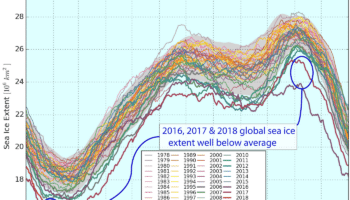
The ice caps were going to melt. They were going to be gone by now, but now they're setting records
Latest in
Claim:
The ice caps were going to melt. They were going to be gone by now, but now they're setting records
Many stories were written about climate science in 2017, but were the ones that “went viral” scientifically accurate? To find…
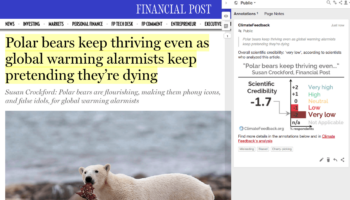
“The article contains valid information on the devastating consequences of climate change on polar bears. The only problem as I see it is that the article presents (implicitly) that the polar bear in the video is dying as a consequence of climate change and from not finding enough food due to lack of sea ice…”
“The article explains the issue (meat production diverts crops from humans to cattle) on a simple level. More explanation and more context could have been provided, I think, regarding individual-level and sectoral sources of greenhouse emissions.”
“The article handles a complex topic well. It would be easy to be alarmist with this subject matter, and while its lede edges that way, the main content of the article is very balanced. It also presents a lot of interesting information in a compelling manner.”
“The article accurately reports on the state of Arctic sea ice at the annual maximum (in March) and its causes, and gives an insightful discussion as to the implications. There is one point which may be misleading…”
“Repeating a version of a debunked argument against climate change science, this biased and misleading political article states that the cancellation of an Arctic research cruise due to increased sea ice at one time and in one region proves climate scientists don’t know anything about climate change over 100 years, which is patently false.”
“While the information in this article is essentially correct, the links lead to loosely related articles published on the same website, rather than articles that directly support the statements made in the article. The explanation of the acceleration of sea level rise in Florida is oversimplified, probably because it is difficult to summarize concisely.”
“A clear and accurate article on the temperature record in 2016, looking back at the records in 2015 and 2014. The article places them in the proper context of long-term warming, while mentioning the special effect that helped make the year a record.”
“The content is almost all correct, but the attention-grabbing headline is wrong and isn’t supported by the quotes from two scientists or by the rest of the content.”