
BBC Today airs false statements by Lord Lawson in the name of balance
On Thursday August 10, BBC Radio 4’s “Today” broadcasted an interview in which Nigel Lawson commented on Al Gore’s new…
Latest in
On Thursday August 10, BBC Radio 4’s “Today” broadcasted an interview in which Nigel Lawson commented on Al Gore’s new…
Claim:
The IPCC, the Intergovernmental Panel on Climate Change, which is sort of the voice of the consensus, concedes that there has been no increase in extreme weather events.
Claim:
according, again, to the official figures—during this past 10 years, if anything, mean global temperature, average world temperature, has slightly declined
“This is an accurate, concise summary of the slowdown of the Atlantic Meridional Overturning Circulation (AMOC) and its possible future states. There are a couple of minor issues: specifically, one of the links goes to an irrelevant article, and it would be useful to have a couple more citations to the scientific literature. The title is possibly a little overstated; I might instead say that the AMOC is at risk of collapsing in a warming world.”
“This is a very simplistic, almost naive op-ed on climate change impacts. Some assertions such as the one about CO2 being good for plants demonstrates that the authors do not know or understand how increasing CO2 is good or bad for plants, they are just repeating something they heard.”
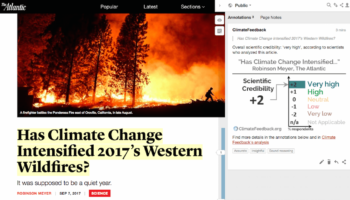
The scientists who have reviewed the article confirm it accurately reports that 2017 is on track to being one of the warmest years on record. Reviewers note this wasn’t as unexpected as the article states, but the fact that 2017 global surface temperature are that high is a clear reminder that global warming has not stopped or slowed down.
“While it is clear that ongoing warming of the global climate would eventually have very severe consequences, the concept of the Earth becoming uninhabitable within anywhere near the timescales suggested in the article is pure hyperbole. The author has clearly done very extensive research and addresses a number of climate threats that are indeed major issues, but generally the narrative ramps up the threat to go beyond the level that is supported by science.”
“In a cursory attempt at both reporting and climate science, the author glibly highlights a document heavy on accusation and light on reasoned engagement with fact. Implying nefarious motives behind temperature measurement bias correction without providing readers any indication of why this is necessary is misleading and a dereliction of the author’s journalistic responsibility.”
Claim:
Trump's action could push the Earth over the brink, to become like Venus, with a temperature of two hundred and fifty degrees, and raining sulphuric acid.
This story in The Atlantic by Robinson Meyer describes a new study on the distribution of economic impacts that result from continued climate change in the United States. The study finds that the impacts would not be uniform throughout the country, but would reduce GDP to a greater degree in southern states, for example, while the northernmost states could experience net economic benefits from warmer temperatures.