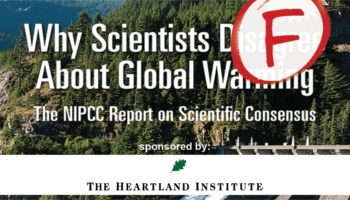
Global warming has not “ceased”, as Heartland Institute report falsely claims
Claim:
global warming ceased around the end of the twentieth century and was followed (since 1997) by 19 years of stable temperature
Latest in
Claim:
global warming ceased around the end of the twentieth century and was followed (since 1997) by 19 years of stable temperature
Claim:
Increases in atmospheric CO2 followed increases in temperature. Therefore, CO2 levels could not have forced temperatures to rise.
“Generally scientifically sound, but caution should be displayed before basing discussion solely on a single modeling study, especially when it incorporates fundamentally different processes relative to other contemporary models.”
Claim:
[climate models] systematically over-estimate the sensitivity of climate to carbon dioxide ... and modelers exclude forcings and feedbacks that run counter to their mission
“The writing is a bit over the top, but factually correct in general. The main weakness is in linking the solidly evidence-based observed changes from the Commane et al paper with much more speculative links such as the Siberian methane bubbles.”
Claim:
Melting of Arctic sea ice and polar icecaps is not occurring at ‘unnatural’ rates and does not constitute evidence of a human impact on the climate.
The author has removed two paragraphs and changed the title, but the new version of the article does not contain any mention of the fact that the article has been updated.
“The article contains little to no rational treatment of observational data, but relies on heavily biased secondhand interpretation… Even the title is based on a lie. There is no ‘study’ that finds static temperatures for 19-years. This article is based on a newspaper article that makes this false statement based in turn on a blog post…”
“This article suffers from a common error in reasoning. The author focuses on individual “snapshots” of the state of the climate while ignoring the long-term trends. Those trends occur over many decades and must be observed/considered over those time scales.”
Claim:
Best available data show sea-level rise is not accelerating. Local and regional sea levels continue to exhibit typical natural variability—in some places rising and in others falling.