
- Health
German placenta study didn’t show COVID-19 mRNA vaccines are harmful
Key takeaway
Pregnant women are at a greater risk of COVID-19 complications and death, and published studies have found that COVID-19 vaccination reduces the risk of complications for both mother and child. COVID-19 mRNA vaccines stimulate cells to produce SARS-CoV-2 spike protein in the body. This trains the immune system to recognize the protein, allowing it to respond quickly in the event of an infection. However, studies so far haven’t shown that the amount of spike protein produced following mRNA vaccination results in harm during pregnancy.
Reviewed content
Verdict:
Claim:
Vaccine-derived spike protein is harmful, its presence in placenta linked to rise in infant mortality
Verdict detail
Misrepresents source:
The study reported finding vaccine-derived spike protein in the placenta, but it didn’t report that this produced harmful effects. The authors didn’t establish a correlation between the presence of spike protein in the placenta and negative pregnancy outcomes.
Full Claim
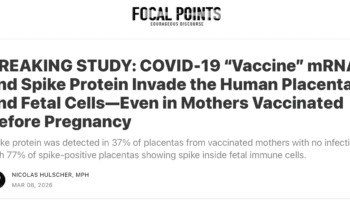
‘COVID-19 “vaccine” mRNA and spike protein INVADE the human placenta and fetal cells […] These findings explain why infant mortality began to increase in 2021—immediately following the mass vaccination of women of childbearing age—reversing a 30-year decline.’
Review
In early March 2026, a published study in the journal PLOS One reported finding spike protein in the placentas of women who had been vaccinated against COVID-19 and women who had been infected by SARS-CoV-2[1].
Shortly after, the study made the rounds on social media, primarily shared by those opposed to COVID-19 vaccines. One example that was reshared numerous times is this X post by Nicolas Hulscher, who previously spread misinformation about vaccines. Through his post, Hulscher shared his article about the PLOS One study, citing it as evidence that the COVID-19 mRNA vaccines are “toxic” and linked to an increase in infant mortality in 2021. The X post was viewed more than 140,000 times.
Posts making similar claims appeared on other platforms including Telegram, and in different languages, including German and Italian.
False claims that the COVID-19 vaccines harm pregnant women and fetuses have been propagated by anti-vaccine groups, each time taking on different forms, whether it’s by misinterpreting published studies or incorrectly analyzing data.
It’s also noteworthy that two of the study authors, Vanessa Schmidt and Ulrike Kämmerer, are members of the Germany-based group “Mediziner und Wissenschaftler für Gesundheit, Freiheit und Demokratie” (Physicians and Scientists for Health, Freedom, and Democracy), which opposed COVID-19 measures, such as lockdowns, during the pandemic. Among the ranks of the group’s members are Sucharit Bhakdi and Heiko Schöning, who spread misinformation about COVID-19 and vaccines.
In this review, we show that the PLOS One study doesn’t provide evidence of COVID-19 vaccine harms during pregnancy, and claims to the contrary overstate and misrepresent the study’s findings.
What the study did and what it reported
The placenta is a temporary organ that forms in the uterus during pregnancy and is responsible for providing oxygen and nutrients to the developing fetus, as well as removing waste materials from the fetus’ blood. In addition, it produces hormones which stimulate changes in the mother’s body that facilitate pregnancy. Scientific evidence also indicates that it plays a role in regulating immunological responses.
The study authors wanted to find out whether spike protein could be found in the placentas of women who had COVID-19 during pregnancy or who were vaccinated against COVID-19, or both. They also wanted to determine whether the spike protein could be transmitted to the fetus through the placenta. This type of exploratory study helps lay the foundation for future research into the potential effects of spike protein on the fetus.
The study included 106 women who gave birth between November 2020 and October 2022. Of the 106 women, 92 were vaccinated. The majority of vaccinated women (90.2%) received at least two doses. 14 women were unvaccinated.
Note that the study population was primarily limited to women who had medically uncomplicated births. The study excluded unvaccinated women who weren’t diagnosed with COVID-19—presumably because this group isn’t expected to test positive for spike protein, the study’s target of interest—as well as women whose placenta samples were insufficient for the study. Women who had miscarriages were also excluded. The authors also stated that “most of women (sic) with an expected premature or complicated birth did not agree to participate in the trial”.
To detect spike protein, virus RNA, and vaccine-derived RNA in placental tissue, the researchers used immunohistochemistry techniques. These techniques use antibodies that have been tagged with a marker to bind to the target molecule of interest in a tissue sample. The marker highlights the target molecule with color, so that the molecule can be visually detected under the microscope.
Using these techniques, the authors reported that of the 106 placental samples, 31 tested positive for the spike protein: three were from unvaccinated women who tested positive for SARS-CoV-2 during pregnancy, 11 came from vaccinated women who reported no infection, 12 from vaccinated women who tested positive for infection, and 5 from vaccinated women who had an unspecified respiratory disease during pregnancy.
The authors also reported finding traces of vaccine-derived RNA in two placental samples, but no trace of the virus RNA.
They concluded that their “findings may suggest a potential for transplacental transfer or cellular uptake” of spike protein. However, the authors acknowledged that given the descriptive nature of the study, they were unable to determine “the clinical significance of this phenomenon”.
Study didn’t report harm from spike protein in placenta
Although posts by Hulscher and other vaccine opponents claimed the study demonstrated that the COVID-19 mRNA vaccines are harmful to the fetus, no data from the study supports this claim.
The researchers stated that they “did not notice any significant differences between vaccinated and unvaccinated women related to routine obstetric features or infant outcome at birth”. They also noted “[n]o correlation” between spike protein or vaccine-derived RNA detection in the placentas and the medical outcome of mother and child, though they attributed this to the study’s inclusion criteria and the small sample size.
Science Feedback reached out to Victoria Male, an associate professor in reproductive immunology at Imperial College London. In an email, she told Science Feedback that “this study doesn’t show any harm from mRNA COVID-19 vaccination during pregnancy”, consistent with the findings of much larger studies published earlier[2].
She also expressed doubt over the interpretation of the study’s experimental results.
“I am not convinced that the study has really shown vaccine-derived spike protein in the placenta,” she said. “The [immunohistochemistry] staining presented is very diffuse, in a way that could reflect the antibody binding to proteins other than spike. To be confident that the antibody is genuinely detecting spike protein, I would want to see staining of a pre-pandemic placenta that shows no signal at all.”
Moreover, earlier studies that included a similar number of people didn’t find spike protein in the placenta. “If spike protein is really found in the placenta of one-third of people vaccinated in pregnancy, it is extremely surprising that this has not been reported previously,” she said.
We reached out to the study’s authors, who did not respond to our request for comment.
Research about the effects of COVID-19 mRNA vaccination on the developing fetus remains relatively limited. But the research so far doesn’t suggest cause for concern.
For example, an in vitro study using human placental cell lines and explants (a type of cell culture that directly uses tissue harvested from an organism) found that exposure to COVID-19 mRNA vaccines didn’t trigger an inflammatory response from the cells “in contrast to COVID-19 infection, which is known to alter placental and fetal immune status, even in mild infections”[3].
A study of pregnant mice immunized with the Moderna COVID-19 mRNA vaccine reported that vaccine mRNA could be detected in the fetus within an hour after vaccination[4]. Moreover, it found that maternal COVID-19 vaccination could stimulate fetal immune cells to produce antibodies against the spike protein.
This finding suggests that maternal vaccination could provide an infant with protection from COVID-19 not only through the transfer of maternal antibodies to the fetus (passive immunity), but also by stimulating the fetus’ own immune system to produce antibodies (active immunity).
However, these findings come from an animal study, and it’s unclear whether the same effects also take place in humans. The authors noted that the architecture of the mouse placenta differs from that of the human placenta, which could influence the results.
Finally, a study in the Netherlands which examined 180 placentas reported that maternal COVID-19 vaccination reduced the risk of SARS-CoV-2 placentitis (inflammation of the placenta) as well as stillbirth[5]. Indeed, as documented in previous Science Feedback reviews, published studies haven’t found an association between COVID-19 mRNA vaccination and a higher risk of negative outcomes in pregnancy.
COVID-19 vaccination isn’t associated with higher infant mortality
In his article, Hulscher asserted that the study’s findings “help explain why infant mortality began to increase in 2021”, but this attempt to correlate infant mortality with COVID-19 mRNA vaccination and imply causality is misleading.
Provisional statistics from the U.S. Centers for Disease Control and Prevention (CDC) did report that infant mortality increased by 3% from 2021 to 2022, representing “the first year-to-year increase in the rate since 2001 to 2002”. But these statistics for infant mortality didn’t stratify child deaths based on the mother’s vaccination status, as Science Feedback pointed out. We therefore cannot draw an association between infant mortality rate and COVID-19 vaccination status.
In fact, there were similarly small increases in U.S. infant mortality year-on-year from 2004 to 2005, 2006 to 2007, and 2014 to 2015 (see Figure 1 below). But these increases didn’t buck the overall trend of declining infant mortality over the past decades.

Furthermore, if COVID-19 vaccination was linked to increased infant mortality rates, one could postulate that infant mortality rates would be higher in states with higher vaccination coverage. However, the CDC reported that the increase in mortality rate was only significant in four states: Georgia, Iowa, Missouri, and Texas. Yet all four had COVID-19 vaccine coverage that was lower than the national average at that time.
We reached out to Hulscher for comment and will update this review if new information is available.
When the data is viewed more broadly, it becomes clear that infant mortality rates haven’t risen significantly since the introduction of the COVID-19 mRNA vaccines for the general public in 2021. The CDC report on provisional infant mortality rates in 2024 stated that “From 2023 to 2024, the neonatal mortality rate was essentially unchanged (from 3.65 to 3.66), while the postneonatal mortality rate declined 5% (from 1.96 to 1.87)”.
And as Figure 2 below shows, data from the United Nations demonstrates that in developed countries where the COVID-19 vaccine was accessible to the public, no significant rise in child mortality since 2021 can be observed.

Conclusion
A study by researchers in Germany reported finding spike protein in the placentas of women who had COVID-19 or who had had been vaccinated against COVID-19. But it didn’t link this to negative outcomes for either the mother or the fetus.
Pregnant women are at a higher risk of complications and death from COVID-19. The disease also increases the risk of miscarriage and premature birth. COVID-19 vaccination helps protect mother and baby by reducing the risk of these complications.
Reviewers’ feedback

Victoria Male
Associate Professor, Imperial College London
This study doesn’t show any harm from mRNA COVID-19 vaccination during pregnancy. The authors recorded the length of the pregnancy, weight of the baby, baby’s physical condition at birth and whether they needed to be admitted to the neonatal intensive care unit. There was no difference between vaccinated and unvaccinated groups for any of these. This is consistent with the findings of much larger studies[2], which also find no harm associated with mRNA COVID-19 vaccination during pregnancy.
If we were confident that vaccine-derived spike protein is present in the placenta, as this study claims, then these results would actually support the idea that such protein is not harmful to either the mother or the fetus. However, I am not convinced that the study has really shown vaccine-derived spike protein in the placenta! The staining presented is very diffuse, in a way that could reflect the antibody binding to proteins other than spike. To be confident that the antibody is genuinely detecting spike protein, I would want to see staining of a pre-pandemic placenta that shows no signal at all.The study included 30 vaccinated participants with no evidence of infection. Spike protein detection was reported in 11 of these. If spike protein is really found in the placenta of one-third of people vaccinated in pregnancy, it is extremely surprising that this has not been reported previously. Prahl looked at 20 people vaccinated against COVID during pregnancy and Santos at 48 without detecting any spike protein[6,7].
References:
- Bartmann et al. (2025) Detection of spike protein in term placentas of COVID-19 vaccinated and/or SARS-CoV-2 infected women. PLOS One.
- Fernández-García et al. (2024) Effectiveness and safety of COVID-19 vaccines on maternal and perinatal outcomes: a systematic review and meta-analysis. BMJ Global Health.
- Gonzalez et al. (2023) Minimal mRNA uptake and inflammatory response to COVID-19 mRNA vaccine exposure in human placental explants. iScience.
- Chen et al. (2025) mRNA-1273 is placenta-permeable and immunogenic in the fetus. Molecular Therapy Nucleic Acids.
- Zels et al. (2024) COVID-19 vaccination protects infected pregnant women from developing SARS-CoV-2 placentitis and decreases the risk for stillbirth. Placenta.
- Prahl et al. (2022) Evaluation of transplacental transfer of mRNA vaccine products and functional antibodies during pregnancy and infancy. Nature Communications.
- Santos et al. (2022) Absence of SARS-CoV-2 Spike glycoprotein expression in placentas from individuals after mRNA SARS-CoV-2 vaccination. Modern Pathology.


