

Search results for: "live edi vs capung"
-
-
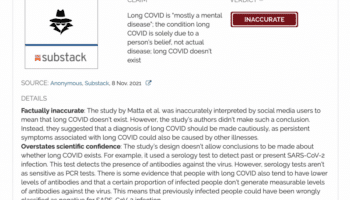 Inaccurate
 -

European Science-Media Hub Workshop ‘Tackling misinformation and disinformation in science’
…and editors about its scientific credibility. Science Feedback is broadening this approach to other scientific fields prone to misunderstandings or organised campaigns of disinformation (e.g. health, see HealthFeedback). One of…
-

European Fact-Checking Standards Network Announces First Annual Conference
…by Climate Editor Darrik Burns at the annual Conference. The day’s sessions will cover a range of topics impacting fact-checkers and the anti-disinformation community across Europe. Among the highlights is…
-
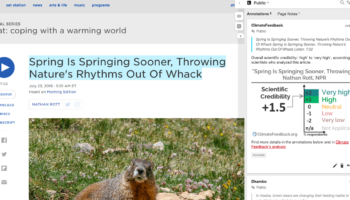 1.5Very high
NPR story accurately describes ecological consequences of altered spring timings in a warming climate
…edited for clarity). In Alaska, brown bears are changing their feeding habits to eat elderberries that ripen earlier. Dasvinder Kambo PhD Candidate, Queen’s University This was a good paper they…
-
 Incorrect
Scientific studies established clear links between human-caused increased in atmospheric CO2 and global warming
Claim:
“It’s a good thing that we are putting some more carbon dioxide in the atmosphere. The scientific method has not been applied in such a way as to prove that carbon dioxide is causing the Earth to warm.”
Source: Instagram, Patrick Moore, 2020-12-16 -

-
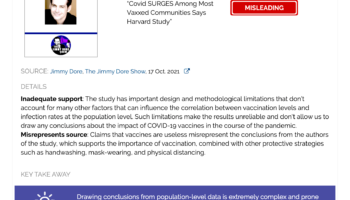 Misleading
Claims that a Harvard study showed COVID-19 vaccines are ineffective misrepresent the authors’ conclusions, fail to account for the study’s limitations
Claim:
“Covid SURGES Among Most Vaxxed Communities Says Harvard Study”
Source: The Jimmy Dore Show, Jimmy Dore, 2021-10-17 -
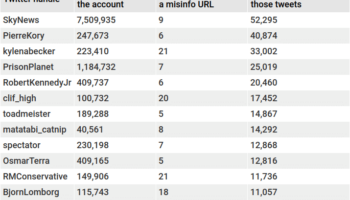
Following the misinformation URL trail to identify key spreaders: A case study on Twitter
…content is user-generated, they’re not editorially controlled and warrant their own approach. This left only websites publishing their own content. Just 20 of those domains were responsible for 54.0% of…
-
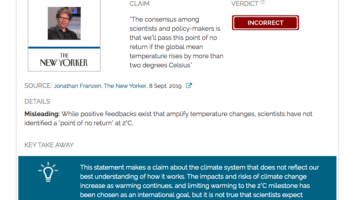 Incorrect
2°C is not known to be a "point of no return", as Jonathan Franzen claims
Claim:
The consensus among scientists and policy-makers is that we’ll pass this point of no return if the global mean temperature rises by more than two degrees Celsius
Source: The New Yorker, Jonathan Franzen, 2019-09-08