
- Climate
The reality of solar geoengineering: science against the conspiracy theories

Scientists have a clear picture of what “geoengineering” means – it’s a set of methods we might one day use to help cool the planet and counteract the warming effects of climate change.
On social media, however, you may find a very different picture. “Geoengineering” conjures up all sorts of conspiracy theories about shadowy forces modifying the atmosphere. For example, you may see claims that aircraft are spraying chemicals into the air or that governments are using radar installations to control storms.
These sorts of claims are not new, but they continue to circulate. In fact, they’ll sometimes reference real geoengineering projects and cite them as evidence of a conspiracy.
So, when someone talks about “geoengineering”, it can be difficult to tell what is real science and what is a conspiracy. Some U.S. states, for example, have passed laws banning “solar geoengineering”.
In this Insight, we’ll explain the difference between the conspiracy theories around “geoengineering” and what that term actually means to scientists carrying out geoengineering research. As we’ll describe, there’s no evidence that solar geoengineering is being used to manipulate the weather.
Main Takeaways:
- The scientific idea of geoengineering has no relation to conspiracy theories about weather manipulation. Instead, geoengineering is something we might someday use to cool the planet and counteract the warming effects of climate change.
- This scientific idea of geoengineering is also known as solar radiation modification, or SRM. There are several different proposed SRM methods.
- Crucially, geoengineering has never been deployed on a scale that would make a difference to the global climate. So far, geoengineering has been limited to very small-scale experiments that test if the technology can work at all.
- Geoengineering is very controversial in the scientific community, so even those small-scale experiments face a lot of scrutiny. This is a major reason that geoengineering has not been tried at a large scale.
- It would therefore be extraordinarily difficult for a major geoengineering effort to play out in the shadows without any public knowledge.
What is solar geoengineering?
Conspiracy theorists and social media posters may use “geoengineering” in claims that shadowy forces are using advanced technology to modify the weather for insidious purposes. The reality is far more mundane.
“Geoengineering” is a real concept, but it has very little in common with the conspiracy theories. Scientists have proposed several ideas to cool the planet in response to climate change. Importantly, these ideas mostly exist on paper. None have ever been used on a large scale.
Our planet is warming because greenhouse gases like CO2 trap the Sun’s energy as heat in the atmosphere[1]. Geoengineering would counter global warming by creating artificial cooling. It would find ways to reflect more sunlight back into space or to reduce the amount of sunlight that Earth absorbs.
Because geoengineering is all about redirecting where the Sun’s energy goes, scientists more commonly refer to this technology as solar radiation modification, or SRM. For clarity, we’ll refer to geoengineering as SRM from here on.
How might this be done? Scientists have proposed a few different ways (Figure 1):
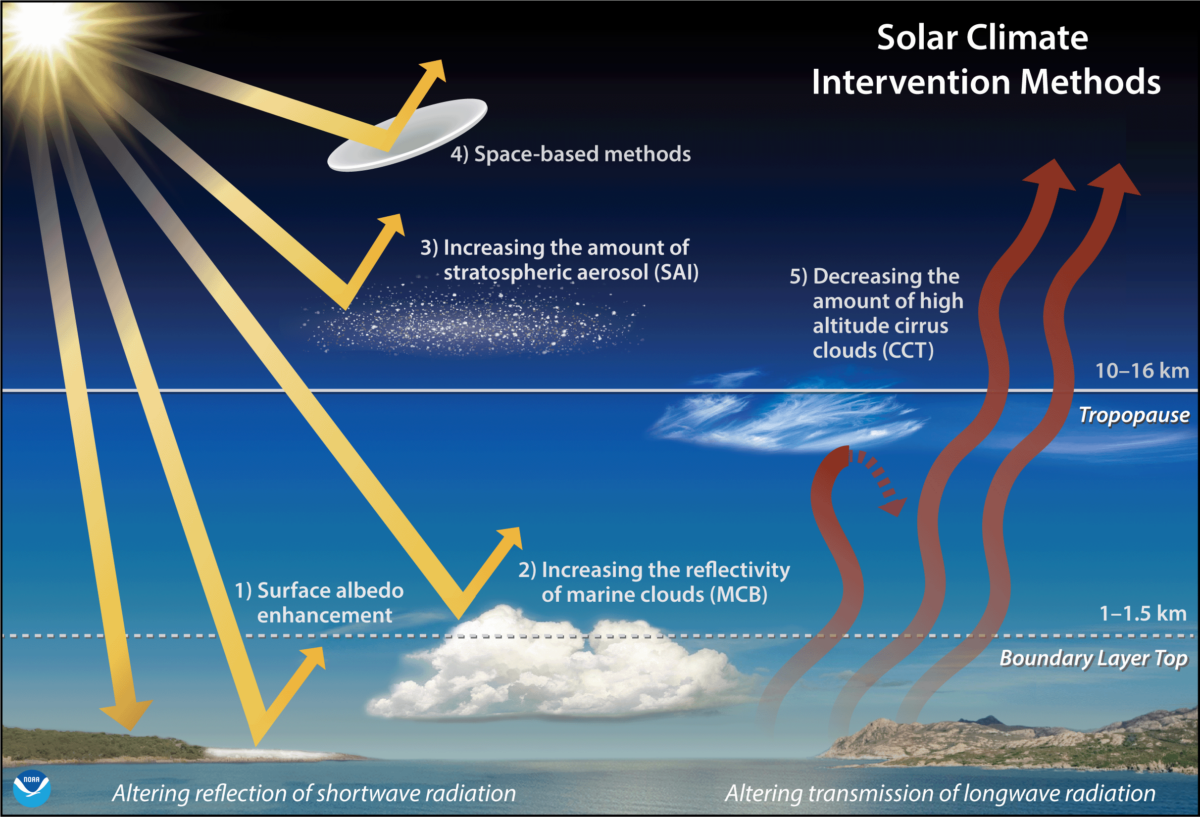
You can see how these compare to each other in the figure above:
- We could release small particles high in the atmosphere to scatter more sunlight back into space. This is called stratospheric aerosol injection or SAI (#3 in Figure 1). It’s probably the best-known form of SRM.
- We could modify clouds. Different sorts of clouds have different effects on the climate, so there are a few different ideas on how to do this. High-altitude cirrus clouds tend to absorb heat, so we could dissolve them to prevent their heating (#5).
- Conversely, low-altitude clouds over water tend to reflect sunlight, so we could brighten them to reflect away more light (#2). Scientists call this marine cloud brightening or MCB.
- We could lighten the color of Earth’s surface to reflect more sunlight – increasing what scientists call Earth’s albedo (#1). Like wearing a white shirt on a sunny day, increasing Earth’s albedo has a cooling effect. We could create white-colored foam in parts of our oceans or plant large fields of light-colored crops.
- Perhaps most ambitiously, we could build mirrors in space to block sunlight from entering Earth’s atmosphere in the first place (#4).
Importantly, again, none of these things have been done at a large scale. The solar geoengineering experiments we’ve seen so far are all early-stage tests that try to determine if these methods work on a small scale. So what have those looked like?
What tests have we seen?
Not many. SRM360, a nonprofit that studies solar geoengineering efforts, counted just nine outdoor SRM experiments that had been attempted prior to June 2025. Three of those nine had been canceled (Figure 2):
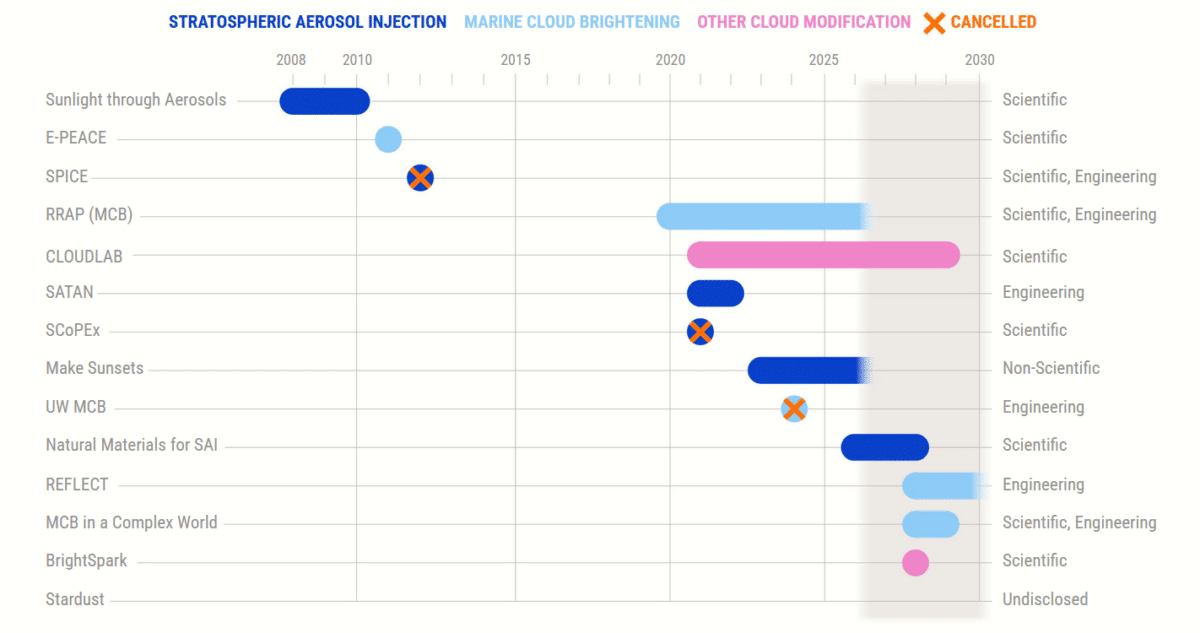
Here are two examples of what has been done:
- Since 2020, as part of a project to protect the Great Barrier Reef, Australian researchers have sprayed modest quantities of sea salt particles from a ship at sea into the atmosphere. They’re testing whether those particles can reach the clouds at all. (Early results suggest the method can work, but the experiments so far have not used enough particles to have any real climate effects.[2])
- Since 2021, researchers from ETH Zurich in Switzerland have sprayed ice-forming particles into the air and studied what they do to low-lying clouds. This experiment, called Cloudlab, helps us better understand what happens inside a cloud. This can improve our weather forecasting models, but the researchers say it can also tell us what may work in future SRM cloud modification projects.
There are likely more planned in the years ahead. For example, the Advanced Research + Invention Agency (ARIA), a UK government agency that funds research, has announced support for additional SRM projects. The list of projects that have received funding is public and anyone can read it, here:
Some of the proposals include:
- Releasing electrically charged particles from a small drone to test if they can successfully brighten clouds.
- Testing a prototype seawater sprayer to check if it can actually do its intended function of spraying particles into the air – a test of a proposed marine cloud brightening system before it even touches any clouds.
- Lifting a box of natural mineral dust into Earth’s stratosphere to study what the cold, thin air will do to the particles. This experiment will not release any particles from the box; it will only test if those particles survive, telling us if we can use them for SAI one day.
As you can see, experiments like this aren’t trying to ‘control the weather’ or anything grand. They are far more modest. They are testing whether different SRM methods can work at all. Imagine that you’re designing the world’s largest skyscraper – these tests are like building a scale model on your desk to test if your design is structurally sound.
Misinformation often tries to play up the significance of research like this. For example, some online claims suggest that ARIA is trying to control the weather or that the UK government is ‘blocking the sun’. But, again, the sorts of experiments that ARIA is funding don’t have the capacity to make large-scale changes. If SRM is ever used on a large scale, that will be years away.
Scientists disagree on solar geoengineering
It’s worth noting that SRM is very controversial within the scientific community.
Social media posts might have you believe that there’s a conspiracy to alter the weather, but they ignore the fact that there’s a very public debate among the scientists who would be responsible. In fact, this debate is often more public than the actual experiments themselves.
On one side, many scientists want a freeze on all SRM use. They believe the dangers of SRM outweigh any potential benefits. They may believe that:
- We’ll never fully understand SRM’s risks – SRM methods could backfire and cause unpredictable harm to humans or their environments.
- SRM may have global effects, and no one is capable of governing its use on that scale. If SRM does go wrong, no one will be able to control it.
- SRM does nothing to address the root cause of global warming: it doesn’t reduce our greenhouse gas emissions. Fossil fuel interests, climate change deniers, or obstructionist politicians could use SRM as an excuse to avoid reducing emissions or transitioning away from the fossil fuels that cause them.
On the other side, proponents believe that SRM can be part of our toolset for relieving the effects of climate change[3]. Proponents support further research so that we know if and how we can use SRM responsibly. They may believe that:
- If we find evidence that SRM can help reduce warming, rejecting it would be as risky as using it.
- We’ve already overshot the Paris Agreement’s goal of limiting global warming to 1.5°C by 2100. If we still want to hold the planet to that goal, we’ll need to do more than merely reduce emissions – we’ll need technology like CO2 removal or SRM that can actually counteract the effects of climate change itself.
- Even if we do limit climate change to that 1.5°C goal, every fraction of a degree that we can reverse matters – SRM could help us reduce the severity of storms and heat waves.
Science Feedback doesn’t endorse either position, but we do point out that both sides’ arguments – including those of geoengineering’s opponents – are very different from unscientific conspiracy theories about chemtrails and shadowy projects. Even some mainstream reporting tends to compare scientists’ opposition to SRM to anti-geoengineering laws.
This scientific debate is ongoing, and it means that even small-scale solar geoengineering experiments face a lot of scrutiny. For example, in 2021, a Harvard-based group canceled an SRM experiment over northern Sweden after opposition from environmentalists and local Indigenous groups.
Similarly, a small-scale test in Alameda, California, run by a University of Washington group, was canceled in 2024 after local government officials protested they had not been informed. The incident was handled publicly and not secretly.
Private solar geoengineering efforts face scrutiny, too
All these projects come from formal academia, and they come with strict environmental controls over what they can and can’t do. What if someone decided to bypass that and start trying solar geoengineering on their own?
As it happens, some efforts have, such as a startup named Make Sunsets and the provocatively named Stratospheric Aerosol Transport and Nucleation (SATAN). They have only succeeded in getting a lot of attention (and backlash) from scientists.
After Make Sunsets conducted operations in Mexico, the Mexican government banned it. Furthermore, scientists working on more formal SRM projects heavily criticized SATAN as lacking scientific merit. One speculated to MIT Technology Review that the name may have been deliberately chosen to gain attention.
Misinformers sometimes say that ‘the UK government is funding SATAN’. In reality, this isn’t an accurate statement. SATAN itself has not received UK government funding through ARIA (see above), and SRM at large is not called ‘SATAN’. Implying that other SRM projects are called ‘SATAN’ is misleading.
What are we to make of this? If a large-scale solar geoengineering experiment really existed, it would most likely not be a shadowy secret. There would be a very public debate in the scientific community. Chances are this debate would rage for years before anything actually happened.
Solar geoengineering is not used to control the weather
There’s considerable overlap between conspiracy theories about geoengineering and conspiracy theories about modifying the weather. Conspiracy theorists will often claim that some of the methods we’ve discussed are being used to control the weather, instead of trying to influence the climate.
Some SRM ideas like stratospheric aerosol injection and marine cloud brightening may seem similar to conspiracy theories: for example, “chemtrails”, the decades-old belief that aircraft are spraying chemicals into the air for weather control or other purposes.
These are not fringe beliefs – according to a 2025 survey that asked members of the U.S. public about solar geoengineering, over 20% of respondents believed the U.S. government ran a secret program that used aircraft to spray chemicals into the atmosphere[4].
Benjamin Redmond Roche, who studies SRM at University College London, writes in The Conversation:
[…] claims like these are widespread online and increasingly find their way into political rhetoric. This blurs the distinction between conspiracy theories about weather manipulation and the very real scientific debate over solar geoengineering.
However, it’s important to remember that SRM or solar geoengineering is not being done at a large scale.
Moreover, claims of weather manipulation and chemtrails have no scientific evidence. Humans have no ability to control the weather on a large scale as we’ve previously discussed.
Whether we should be using solar geoengineering is a real argument, and we don’t take sides in that argument. However, from a fact-checking perspective, it’s important to be clear about what “solar geoengineering” actually is – and what it isn’t – before entering that argument.
References
- 1 – IPCC (2021) Sixth Assessment Report.
- 2 – Hernandez-Jaramillo et al. (2025) First generation outdoor marine cloud brightening trial increases aerosol concentration at cloud base height. Environmental Research Letters.
- 3 – Wieners et al. (2023) Solar radiation modification is risky, but so is rejecting it: a call for balanced research. Oxford Open Climate Change.
- 4 – Buck et al. (2025) Public concerns about solar geoengineering research in the United States. Communications Earth & Environment.


