
Incorrect
Fred Singer incorrectly claims sea level rise is not caused by climate change
Claim:
Sea-level rise does not seem to depend on ocean temperature, and certainly not on CO2

Topics:
Latest in
Claim:
Sea-level rise does not seem to depend on ocean temperature, and certainly not on CO2

“An accurate and balanced article that gives readers a good flavour of the research but the reference to “Earth’s history” might confuse some when it otherwise refers to the studied period: the past 3.5 million years. Neatly explains a lot of the key points in a small word count, but…”
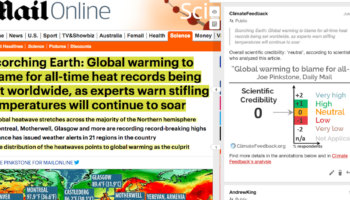
“Mostly this article is accurate in its reporting of the recent heat over North America and Eurasia. However, there are a few misleading statements, including the headline, that exaggerate both the scale of the event and the likely role of climate change.”

“This article selectively cherry-picks studies showing low climate sensitivity, leaving out whole lines of evidence (e.g. paleoclimate studies) that agree with the sensitivity estimates found in models. It also glosses over the many criticisms of instrumentally based (or “energy balance”) sensitivity estimates published in recent years.”

“The article presents the results of the study accurately, and uses multiple comments from scientists both involved and not-involved in the study to highlight the key findings. Some of the explanations are simplified, and there is a slight attempt at the end to downplay the results by suggesting scientists can’t predict the future. It is correct that the study presented is not making predictions, rather documenting past changes, but the positive trend is what we would expect based on the longer record of change we have for glaciers and ice caps.”

“This is an important topic and the article explains the new research findings clearly… Highlighting how this result about slowing storms is consistent across two studies that employ very different methodologies further helps convey to the public how we try to use multiple lines of evidence to understand how our world works and how it may chance in the future.”

“The issue of water resource management in the western US and how it fits within a changing climate is extremely complex and spans many disciplines from climatology to hydrology to city planning to population dynamics, and so on. This article does a nice job presenting the very basics of the climate science involved and tying the greater changes to the personal stories of people in the region.”

“The article has almost nothing to do with the modern state of sea-level science. The author tries to call into question that global warming causes sea-level rise, and does so by cherry-picking a short segment of data from 1915-1945, a time when data quality is poor and the warming signal small—a bizarre approach that could never pass scientific peer review and is apparently aimed at misleading a lay audience.”

“The article draws attention to the high CO2 at present and the health risks of climate change, but it gives the incorrect impression that breathing CO2 directly is a major cause of concern. The most important health effects of climate change—heat stress, vector-borne diseases, air pollution, access to food and water, severe storms, displacement—do get some discussion here.”

“The Australian chooses to present a mixed message on this story when the science is extremely clear. The title and quote from Prof. Kaempf do not represent the views of the broader scientific community.”