
- Health
RFK Jr. spreads unfounded conspiracy theory that Lyme and RSV were engineered
Key takeaway
Historical evidence shows that the infectious agents responsible for Lyme disease (Borrelia burgdorferi) and RSV infection existed long before gene engineering techniques became available. Data from phylogenetic and genomic surveillance studies don’t indicate signs that B. burgdorferi and RSV were recently manipulated in the laboratory. The data is instead consistent with the scenario that both pathogens are the product of evolutionary processes in the wild.
Reviewed content

Verdict:
Claim:
Lyme disease and RSV were engineered in gain-of-function experiments
Verdict detail
Incorrect:
Scientific studies of the bacterium that causes Lyme disease and RSV don’t show the expected hallmarks of recent genetic engineering. On the contrary, the data is in line with the action of evolutionary processes that occur in nature.
Inadequate support:
Kennedy produced no evidence to support his claim that Lyme disease and RSV were the product of genetic engineering.
Full Claim
“COVID-19 pandemic and many other global pandemics that we have, have come from gain-of-function research. The RSV epidemic that we have, that is the biggest killer of kids in this country today, came from these kind(sic) of experiments. Lyme disease almost certainly came from this kind of research.”; “We’ve had too many bad things happen, you know, with Lyme disease that almost certainly came from these [gain-of-function] experiments that is now devastating our country, RSV that came from a laboratory which is now the biggest killer of children in our country.”
Review
On 2 August 2026, U.S. health secretary Robert F. Kennedy Jr. made a slew of inaccurate and unsubstantiated claims in two separate interviews on CNN and Fox News. One of the claims that both interviews had in common was that COVID-19, RSV (respiratory syncytial virus), and Lyme disease were the product of gain-of-function experiments in laboratories.
The conspiracy theory that Lyme disease was a product of bioweapons research has circulated for a number of years. It was also popularized by the book “Bitten”, authored by science writer Kris Newby. The claim regarding RSV possibly stems from an article by Lyn Redwood, an anti-vaccine activist who’s falsely claimed thimerosal in vaccines causes autism. Redwood’s article was published on the website of Children’s Health Defense, an anti-vaccine organization founded by Kennedy. In the article, Redwood alleged that RSV had come from chimpanzees used in labs conducting polio vaccine research.
Kennedy’s claims are consistent with his track record of invoking conspiracy theories when discussing health-related topics such as infectious diseases and vaccines, starting long before he became health secretary. As the claim that COVID-19 was engineered has already been debunked at length by scientists in earlier articles, this review will focus on Kennedy’s claim that Lyme disease and RSV are manmade.
First Records of Lyme and rsv predate the age of gene engineering
Firstly, the gene engineering techniques needed for modern gain-of-function experiments were pioneered in the 1970s. And historical evidence shows that the infectious agents responsible for RSV infection and Lyme disease existed before then. The bacterium responsible for Lyme disease, Borrelia burgdorferi, was identified in a 5,000-year-old mummy known as “Ötzi the Iceman”. As for RSV, it was identified by researchers as early as 1956[1].
In brief, neither pathogen required gene engineering to come into being.
Phylogenetics and genome surveillance don’t show signs of lab engineering
The above information has been countered with the question: “What if scientists took samples of these pathogens from the wild, modified them in the lab to be more infectious, and then released them?”
That question can be scientifically answered by studying how the genome of these pathogens change over time, a little like how scientists study the fossil record to understand how different forms of life on Earth came about. There is plenty of data, both historical and recent, from scientific studies indicating that genetic engineering is an exceedingly unlikely explanation for the disease-causing capabilities of both pathogens.
Take for example an analysis of a collection of nearly 150 Borrelia DNA samples by scientists at Yale[2]. This analysis enabled them to construct an evolutionary tree showing firstly that the bacterium had existed in North America for about 60,000 years, and secondly, that it had likely originated in the northeast of the United States before spreading across the country.
If Lyme disease was the result of genetic engineering, scientists would be able to see signs of this in such an analysis. Sam Telford, a professor at Tufts University who studies Lyme disease, pointed out the following in a 2019 article for The Conversation:
“Population genetics research on Borrelia burgdorferi, the bacterial agent of Lyme disease, suggest that the northeastern, Midwestern and Californian bacteria are separated by geographical barriers that prevent these populations from mixing. Had there been a lab strain, particularly one engineered to be more transmissible, that escaped within the last 50 years, there would be greater genetic similarity between these three geographic populations. There is no evidence for a recent single source – such as a release from a lab – for Lyme disease spirochetes.” [emphasis added]
The history of RSV also doesn’t align with the claim[1]. While it is true that the virus was first isolated from chimpanzees used by researchers at the Walter Reed Army Institute of Medical Research in 1956, the researchers also reported finding that 20% of adolescent individuals had antibodies to the virus. A year later, researchers at Johns Hopkins reported that at least 80% of healthy children had antibodies against the virus by the age of four.
All in all, the findings indicate that the virus had already been circulating in the human population for quite some time. Scientists consider that the chimpanzees were likely infected by their human caretakers, rather than the other way around, a process known as reverse zoonosis.
Like B. burgdorferi, scientists have analyzed RSV’s genomic sequence across time. In fact, RSV genome surveillance is an ongoing effort in various countries, including the U.S., Spain, and Australia, to enable scientists to monitor disease trends. The data from genome surveillance helps inform public health responses to epidemics, such as treatments and vaccine development. This activity is also carried out for other disease-causing organisms like the flu virus.
RSV can be broadly divided into two major subtypes, RSV-A and RSV-B, and these subtypes can be further divided into more lineages. The GISAID website contains a database of genetic sequences from different pathogens, including RSV, contributed by researchers globally. This data shows us what the relative frequencies of different RSV lineages are like in recent times (see below).
If a lab-engineered strain that was much better at causing disease had recently been released, that strain would be expected to quickly outcompete its less infectious naturally-occurring relatives and become the dominant strain. If this was done with RSV as Kennedy claimed, then we would expect a sudden emergence of greater similarity in the RSV strains in recent years.
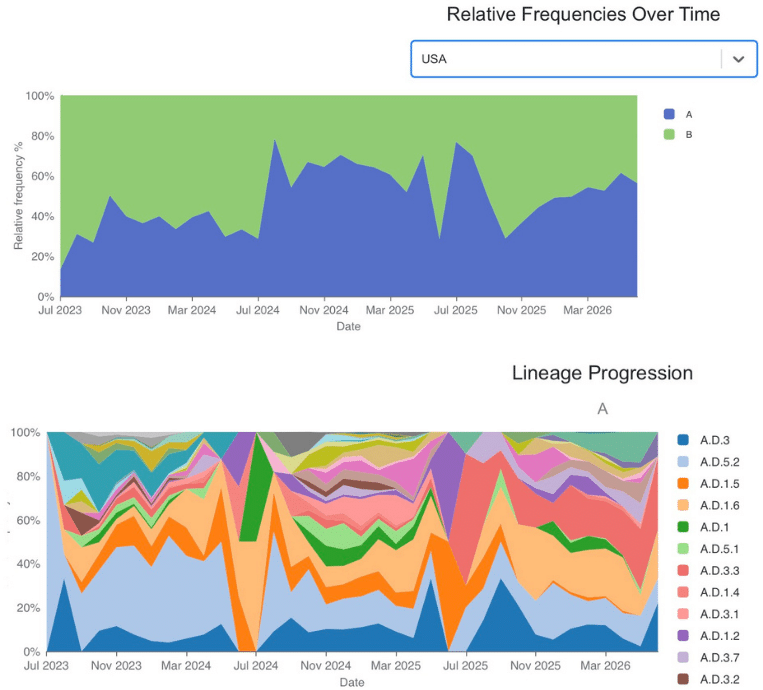
The GISAID data shows us that there continues to be a wide range of RSV lineages detected in the U.S. This observation is inconsistent with the scenario of a lab release of an engineered strain that Kennedy put forward.
Conclusion
In summary, the claim that Lyme disease and RSV are the product of genetic engineering in a laboratory is unsubstantiated by the scientific evidence. We’ve written previously about how infectious disease outbreaks are commonly the target of conspiracy theories. These conspiracy theories prime an audience to distrust advice from experts and to reject public health responses. By stoking and directing fear and anger against scientists and doctors, they distract people and undermine evidence-based efforts to stop the spread of infectious diseases.
References
- Casadevall et al. (2025) The Story behind the Science: On the discovery of respiratory syncytial virus. mBio.
- Walter et al. (2017) Genomic insights into the ancient spread of Lyme disease across North America. Nature Ecology and Evolution.