- Health
Infectious disease outbreaks: a magnet for conspiracy theories

Main Takeaways:
- Conspiracy theories about infectious disease outbreaks tend to start circulating shortly after an outbreak is reported in the mass media.
- They are popular vehicles of misinformation, frequently stoking fear and distrust of vaccines and other public health measures.
- They manipulate emotions by playing on people’s preconceptions and preoccupations about a range of topics, including Big Pharma and governmental overreach.
- Common sources of these conspiracy theories include anti-vaccine and “medical freedom” activists.
- Conspiracy theories don’t improve our ability to mitigate epidemic risk—on the contrary, they undermine evidence-based efforts to prepare for epidemics and thus put people’s lives at risk.
COVID-19, mpox (monkeypox), hantavirus, or Ebola—it doesn’t seem to matter what the disease du jour is—like a Pavlovian reflex, news reports of an infectious disease outbreak trigger a corresponding wave of conspiracy theories on social media.
All sorts of information can be woven into these conspiratorial narratives, ranging from patents to false claims about diagnostic tests to an incorrectly used photo of disease symptoms. Their variety belies their primary objective: to convince people that an outbreak is a hoax or that it was deliberately provoked by a person or a group for various nefarious ends. These narratives spread widely across social media, even though they aren’t substantiated by evidence.
One might be tempted to shrug off this phenomenon as simply a form of entertainment or even dark humor to cope with negative world events, but the consequences of repeated propagation of these conspiratorial narratives are anything but humorous. Scientists have warned that these narratives promote a dangerously flawed understanding of epidemic risk among the general public, undermine trust in public health agencies, and hinder the work needed to prevent and stop pandemics from happening.
To combat these narratives, it is important to be aware of who is likely to spread them, what drives their spread, and the forms that they may take. These factors are the subjects of discussion in this Insight article.
Who is likely to spread conspiracy theories?
Conspiracy theories, unlike scientific explanations of phenomena, are naturally attractive to people for two main reasons. Firstly, they tend to provide a story that is easy to understand since it does not require technical expertise; secondly, they trigger strong emotions like fear and anger that make them highly compelling[1, 2], something that is rewarded by social media algorithms.
These qualities make them a low-hanging fruit for anybody seeking to farm user engagement at any cost. User engagements—likes, shares, comments—signal social media algorithms to recommend certain posts to other users, who then engage with these posts in their turn. This creates a snowball effect that engagement-farming social media accounts capitalize on to build an audience.
When deployed in the context of infectious disease outbreaks, conspiracy theories serve as a reliable workhorse for the constellation of social media accounts dedicated to fostering distrust of public health authorities like the World Health Organization, as well as of vaccines (see examples of posts here, here, here, and here). Unsurprisingly, many of these accounts are anti-vaccine or linked to the “medical freedom” movement which opposes government regulation of medical care, often spreading claims unbacked by scientific evidence.
By repeatedly broadcasting conspiratorial narratives embedded with health misinformation, these movements can promote their agenda and push inaccurate health claims into mainstream consciousness. Through repetition, the false claims start to become more familiar, which normalizes them and makes people more likely to believe them (the illusory truth effect).
Spreading conspiratorial narratives about disease outbreaks can thus be useful for promoting a certain ideological agenda. But it’s also a financial opportunity for certain groups, providing a way to insert thinly veiled advertisements for unproven cures.
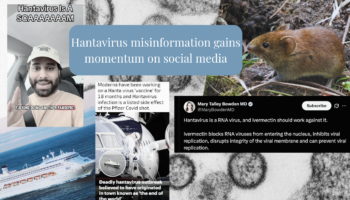
Take for example cardiologist Peter McCullough, who repeatedly spread misinformation about COVID-19 and vaccines and happens to be the chief scientific officer of The Wellness Company which sells ivermectin. As McCullough pushed the baseless conspiracy theory that the hantavirus outbreak was planned by the World Health Organization, he also advocated for ivermectin to be used to treat hantavirus, even though no clinical evidence exists to show the drug is effective against hantavirus.
Competing national ideologies can also be a motivation for spreading conspiracy theories. For example, pro-Russia and pro-China sources pushed the conspiracy theory that the virus SARS-CoV-2 was a bioweapon engineered in an American laboratory. And in the global race to develop a vaccine against COVID-19, the same sources spread misinformation about COVID-19 vaccines developed in Western countries to disparage and undermine trust in these vaccines.
In summary, the motivation to spread conspiracy theories about disease outbreaks can be surprisingly diverse. At times, it may even have nothing to do with a person or a group’s trust (or rather distrust) in public health interventions like vaccines. Therefore, it is useful to take a closer look at the sources of these conspiracy theories: specifically, who is behind the source and what their potential motivations may be.
What do these conspiracy theories look like?
One popular form of these narratives draws on the longstanding “New World Order” conspiracy theory, claiming that a shadowy cabal of “elites” deliberately provokes outbreaks to create a pretext for establishing a “totalitarian one-world government”. Frequent targets of these narratives include the World Health Organization (WHO) and Microsoft co-founder and philanthropist Bill Gates—likely due in no small part to both parties’ role in promoting and supporting vaccination campaigns. The fact that these claims are unsubstantiated by evidence is no obstacle to their popularity (see relevant fact-checks here, here, and here).
A particular lightning rod for conspiratorial narratives is the WHO Pandemic Agreement, which aims to improve global capacity for preventing and responding to public health emergencies. Among its key components is a system enabling countries to quickly exchange biological material and samples for public health purposes, as well as a logistics network to ensure rapid and equitable distribution of health products.
However, conspiracy theorists framed the agreement, or pandemic treaty as it was widely called, as a power grab on the WHO’s part, allowing the organization to usurp the sovereignty of countries, impose national lockdowns, and force people to get vaccinated—even though no language in the agreement mentions any of these things and the agreement has no power to override a country’s sovereignty.
Conspiratorial narratives about outbreaks sometimes cite the existence of a vaccine candidate for a disease or a pandemic preparedness exercise as evidence that an outbreak was planned (see examples here and here). Essentially, any attempt to prepare the human population against an outbreak is misconstrued as evidence of a planned outbreak.
But this line of reasoning doesn’t make sense. It’s equivalent to claiming that fire drills and the existence of fire extinguishers are evidence that fires are deliberate or planned. The truth is that disease outbreaks are a fact of life, as the historical record shows us. In the same way that we prepare for natural disasters like earthquakes and hurricanes, it is good sense to prepare for outbreaks before they hit us, not after. Developing vaccines and running pandemic preparedness exercises are part of that preparation.
In short, conspiracy theories about disease outbreaks tell us more about the people who spread them than they do about the targets of the conspiracy theories, reflecting the former’s preconceptions and preoccupations, whether that is vaccine safety or governmental overreach. While it is normal to have doubts or questions about these things, especially during a time of fear and uncertainty, conspiracy theories don’t provide a sound basis for understanding the world, as they rely on delivering inaccurate or distorted information and manipulating people’s emotions.
Why do conspiratorial narratives feel convincing to people?
Personality traits and lived experiences
Multiple factors influence a person’s vulnerability to conspiracy theories. Certain personality traits, like narcissism, have been associated with a greater acceptance of conspiracy theories and misinformation. Preexisting biases can also cause some people to be more likely to believe conspiracy theories because it validates their beliefs (motivated reasoning). In such cases, information supporting their belief is readily accepted, even if it’s incorrect. On the other hand, information conflicting with that belief is dismissed, even if it’s correct.
But external factors are also important. For example, in times of uncertainty and upheaval—like during an epidemic—conspiracy theories offer psychological comfort by providing a well-ordered narrative to make sense of events. Stephen Lewandowsky, a professor of psychology at Bristol University, told the BBC:
“We do not like the idea that out of the blue something terrible can happen, therefore, it is psychologically comforting for some people to believe in a well-organised conspiracy of powerful people who are responsible for those events”.
Another factor is a deep-seated mistrust of authorities stemming from real events that harmed people[3]. These include past unethical behavior on the part of scientists and public health authorities, like the Tuskegee study, as well as documented instances of scientific misconduct by Big Pharma. Marginalized communities in particular face discrimination and systemic inequality within the healthcare system, which compounds the problem. More broadly, negative encounters with the healthcare system that leave people feeling dismissed and humiliated can leave them more vulnerable to health misinformation.
Convincing falsehoods contain a kernel of truth
The best lies rarely are made up of pure fiction, but contain a kernel of truth that makes them appear more credible and thus more complicated to dismantle. Similarly, not all conspiracy theories can be dismissed as bunk. Abbie Richards, who conducts research into misinformation and extremism, developed a chart that categorizes various conspiracy theories based on how grounded in reality they are. It shows several real examples of powerful groups and interests committing unethical or criminal acts, like Watergate and Big Tobacco.
However, the fact that some conspiracy theories turn out to be true is not sufficient grounds to believe that all conspiracy theories are true. After all, the chart contains far more conspiracy theories that can be proven false by a multitude of evidence, like those related to Flat Eartherism and Holocaust denialism. The human desire for simplicity and the tendency to take cognitive shortcuts can thus increase a person’s vulnerability to conspiracy theories.
Misconceptions over epidemic risk
Understanding disease outbreaks requires a degree of subject-level expertise that most people don’t have. It is therefore easy for conspiracy theorists to take advantage of the public’s poor understanding of epidemic risk.
The scientific evidence on COVID-19, mpox, and hantavirus and Ebola points to zoonotic spillover, or the transmission of a disease-causing microorganism from an animal to a human, as the trigger for the initial spread. But conspiracy theorists reject this explanation, claiming instead that these outbreaks must have been deliberately started by someone.
When every widely publicized outbreak is dismissed as a hoax or a plot, the public can start to perceive naturally occurring outbreaks as rare-to-never events. But prior evidence overturns the idea that outbreaks are more likely to be manmade than natural.
Firstly, zoonotic transmission, as in the case of the four diseases named above, is a very common event. According to the World Health Organization, “[s]ome 60% of emerging infectious diseases that are reported globally are zoonoses”. In fact, many illnesses that people are familiar with, like Lyme disease, malaria, Salmonella, and rabies, are zoonotically transmitted diseases, even though they might not be understood as such by the public.
Secondly, zoonotic transmission is expected to become more common, as contact between humans and wildlife increases due to factors like increased wildstock production for food, as well as climate change that alters ecosystems and animal migration patterns.
In short, outbreaks, including those from zoonotic transmission, are very common events. They occur around the world all the time from natural causes, even though most don’t make the news. Many potential sources of infectious disease outbreaks naturally occur in the environment, rendering human intervention unnecessary.
Conclusion
People should anticipate the appearance of conspiracy theories about a disease outbreak shortly after media reports about the outbreak are published. These conspiracy theories typically provide simple narratives that trigger strong emotions like fear, disgust, and anger, which fuels their spread on social media.
However, “simple” does not necessarily mean “correct” and the goal of conspiracy theories is not to inform, but to promote an agenda by manipulating people’s emotions. Crucially, conspiracy theories do not improve our ability to mitigate epidemic risk—on the contrary, they undermine evidence-based efforts to prepare for epidemics, thereby putting people’s lives at risk.
References
- van Prooijen et al. (2021) The entertainment value of conspiracy theories. British Journal of Psychology.
- Cosgrove and Bahr. (2024) The Language of Conspiracy Theories: Negative Emotions and Themes Facilitate Diffusion Online. Sage Open.
- Kisa and Kisa. (2025) Health conspiracy theories: a scoping review of drivers, impacts, and countermeasures. International Journal of Equity in Health.
These materials were developed in 2026 for the Prebunking at Scale project, with support from the European Fact-Checking Standards Network.