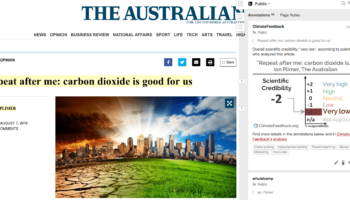
Ian Plimer incorrectly claims human-caused emissions are short-lived
Claim:
The atmospheric residency time of carbon dioxide is five years and it is quickly sequestered into plants, marine life, oceans and sediments.
Latest in
Claim:
The atmospheric residency time of carbon dioxide is five years and it is quickly sequestered into plants, marine life, oceans and sediments.
“This article is an amalgamation of logical fallacies, misleading talking points, and downright factually incorrect statements regarding the physics of the climate system. Every talking point in this article has been debunked many times over and it is astonishing that this was published.”
“The article reasonably summarizes a new study published in PNAS, which describes the potential of tipping elements to enhance climate warming and the potential for the Earth to transition into a hot-house climate state. The article is careful to point out uncertainties and thus avoids being sensational. However, there are many small errors scattered throughout the article.”
Claim:
California wildfires are being magnified & made so much worse by the bad environmental laws which aren’t allowing massive amounts of readily available water to be properly utilized. It is being diverted into the Pacific Ocean.
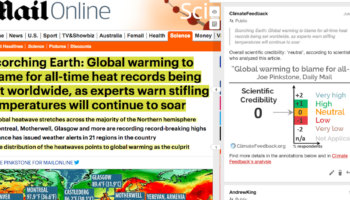
“This article accurately describes the broader climate context of recent heat extremes throughout the Northern Hemisphere. There are a couple spots where specific claims are somewhat stronger than justified by the existing scientific evidence, but in general the piece gives an accurate impression regarding the role of climate change and recent advances in extreme event attribution science.”
“This article at NPR discusses what happens when warm spring weather arrives earlier because of climate change. Animals must adjust to changes in the timing of plant flowering, for example, leading to noticeable desynchrony in the ecosystem…”
Claim:
Sea-level rise does not seem to depend on ocean temperature, and certainly not on CO2
“An accurate and balanced article that gives readers a good flavour of the research but the reference to “Earth’s history” might confuse some when it otherwise refers to the studied period: the past 3.5 million years. Neatly explains a lot of the key points in a small word count, but…”
“Mostly this article is accurate in its reporting of the recent heat over North America and Eurasia. However, there are a few misleading statements, including the headline, that exaggerate both the scale of the event and the likely role of climate change.”
“This article selectively cherry-picks studies showing low climate sensitivity, leaving out whole lines of evidence (e.g. paleoclimate studies) that agree with the sensitivity estimates found in models. It also glosses over the many criticisms of instrumentally based (or “energy balance”) sensitivity estimates published in recent years.”