
Wall Street Journal op-ed ignores evidence of negative impacts of increasing CO2
Claim:
Increased atmospheric carbon dioxide has helped raise global food production and reduce poverty.

Topics:
Latest in
Claim:
Increased atmospheric carbon dioxide has helped raise global food production and reduce poverty.

Claim:
Sea level rise, which was occurring long before humans could be blamed, has not accelerated.
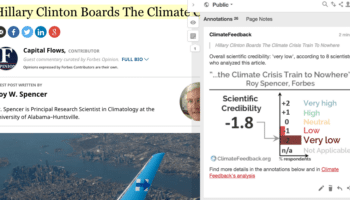
“The article is inaccurate in several places and conveys that one must choose between solving immediate problems, such as poverty, and long-term risks such as climate change. We can do both, and indeed must do both if we take poverty seriously, since climate change disproportionately affects the poor.”

“This article is very interesting because it exemplifies a highly-misleading rhetorical practice that is effective, frequently used, but not easily recognized by the public: “paltering”… A successful palterer will try to avoid being untruthful in each of his/her utterances, but will nonetheless put together a highly misleading picture based on selective reporting, half-truths, and errors of omission…”
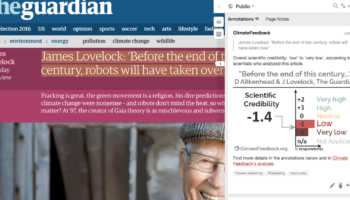
“Extraordinary claims demand extraordinary evidence, and Lovelock has not even come up to the standards of providing what the scientific community would consider to be ordinary evidence. The journalist did not balance Lovelock’s statements with a set of clear statements saying that the vast majority of informed climate scientists (as, for example, represented by the IPCC reports) have reached consensus on conclusions that are diametrically opposed to what Lovelock is saying, and that the IPCC scientists have backed up their statements with a wealth of empirical data, whereas Lovelock is largely opining without providing any substantive evidence to support his rather extraordinary claims.”

“This picking of quotes that are convenient for Robert Bradley Jr.’s narrative while ignoring what most climate scientists say is one of the most used rhetorical tools of this piece. The other is the use of offensive emotional language to reduce the critical thinking of his readers. People should know that Forbes is nowadays just a blogging platform.”

“I find the headline accurate and supported by the article. The article explains the novelty and impact of the research accurately for the general readership and in particular the context provided from the scientists works really well in this regard.”

“The theory of sea-level rise and flood problems is pretty well understood — this makes the point that this theory is also happening now and can only be expected to get worse — sea levels have been rising on the US east coast for the last 150 years or more and even if current trends simply continue, impacts will continue to grow. As the article states, we actually expect a significant acceleration of sea-level rise in the coming decades meaning the impacts will grow more rapidly.”

Claim:
Sea level rise could reach six or seven feet by the year 2100.

“before propagating a marginal view, one should ensure having a very strong argumentation; in this interview no argumentation is put forward to support Peter Wadhams’ central claim. Wadhams’ alarmism is potentially harmful, because when such spectacular predictions are not realized some people may perceive the whole scientific community or science itself as untrustworthy.”