
- Climate
Robert F. Kennedy Jr. likes regenerative agriculture, but what is it?

The phrase of the day in farming might be ‘regenerative agriculture’. Only a few years ago, few people outside of agricultural research had heard the term. Now, the term has spread to the wider public.
That trend has accelerated thanks to the current U.S. Health Secretary, Robert F. Kennedy Jr. Kennedy supports it, and with his backing, the U.S. federal government supports it, too – In December 2025, the U.S. Department of Agriculture announced a pilot program to fund “regenerative” farmers.
So, you might see claims online proclaiming the benefits of ‘regenerative agriculture’ or showing off the difference between ‘regenerative’ and conventional agriculture. You’ll also see food producers touting their products as ‘regenerative’. So, are these things true?
In this article, we’ll examine what ‘regenerative agriculture’ really means, and how Kennedy’s ideas of the term compare with scientists’ ideas of the term. First, we must confront a key problem: the term has no clear definition.
Main Takeaways:
- Agricultural experts noted to Science Feedback that the term ‘regenerative agriculture’ has no single definition. Different groups have different definitions, often at odds with each other.
- There are some farming methods that are commonly considered to be ‘regenerative agriculture’. They include practices that Robert F. Kennedy Jr. and the U.S. Department of Agriculture promote.
- Scientific evidence shows that these methods can increase yields and sustainability in certain circumstances.
- However, in the lack of a single definition, there is little way to verify whether something really is ‘regenerative’ or not.
There is no one definition of ‘regenerative agriculture’
In general, regenerative agriculture’s proponents believe that farmers should prioritize the health of the underlying soil. They say this is more sustainable than squeezing the soil for short-term gains. In comparison, proponents believe that regenerative agriculture leads to higher crop yields, more nutritious food, and better environmental health.
But when we ask what this means in the field, the answer becomes more complicated. There is no single, accepted definition. Different groups and different people have different ideas of the farming and livestock-raising methods that are actually “regenerative”’.
Some definitions of “regenerative” may include some of these practices:
- Planting cover crops, which are plants intended to preserve soil health rather than for harvest
- Crop rotation, or changing the plants grown on a certain field from growing season to growing season
- Reducing tillage (disturbing the soil) or avoiding it entirely
- Using fewer chemicals like pesticides and synthetic fertilizers
- Controlling where livestock can graze in order to keep the soil in good health
- Allowing animals to graze in open space instead of inside buildings
Others think that regenerative agriculture shouldn’t be a list of methods; instead, they say, regenerative practices are anything that work toward certain sustainability goals[1,2]. Some of those goals may include:
- Improved soil health: Keeping nutrients and other beneficial ingredients in the soil
- Increased biodiversity: Preserving the lives of microorganisms and others living in the soil
- Carbon sequestration: Allowing the soil to remove carbon dioxide from the atmosphere
- Maintaining the welfare of farm animals
These aren’t complete lists. There is no ‘complete list’. Different definitions disagree on whether regenerative agriculture should focus on methods, end goals, or both. Some definitions include goals like ensuring farm workers receive fair pay.
As we see, “regenerative” has no single definition, as several agriculture experts noted to Science Feedback:
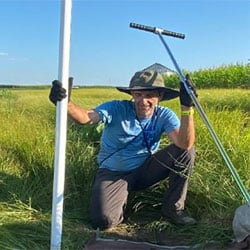
Carl Rosier
Scientist in Residence, Basil’s Harvest
Currently, there is no solid definition.

Peter Newton
Associate Professor, University of Colorado Boulder
I think that many people use the term loosely, without any specific definition in mind. Other people do have a specific meaning in mind when they use the term, and sometimes those people articulate or state their definition. But definitions vary between individuals and organizations, such that two individuals or organizations might both have a clear definition but those two definitions may be very different and indeed may be incompatible with each other.

Ethan Gordon
Postdoctoral Scholar, Oregon State University
The fundamental issue here in my opinion is that “regenerative agriculture” is not a specific approach in the way agroecology, organic agriculture, biodynamics, permaculture, or any of those others are.
You might see products promoted with a label like ‘regenerative-certified’, but not everyone recognizes that label. At least two different non-government organizations – the Regenerative Organic Alliance and the Savory Institute – offer different certifications. Again, there is no one definition.
Kennedy’s statements fit experts’ ideas of regenerative agriculture, but he does not clearly define the term
Let’s compare the above with what Kennedy and the U.S. government say about ‘regenerative agriculture’.
Science Feedback could not find an instance when Kennedy clearly defined the term. However, in past speeches about regenerative agriculture, Kennedy has named a few specific practices. One is no-till agriculture (again, this means that farmers avoid disturbing the soil, which can lead to erosion). Another is to reduce the use of agricultural chemicals (like synthetic pesticides).
Experts told Science Feedback that these practices are common in different definitions of regenerative agriculture:

Renske Hijbeek
Associate Professor, Wageningen University
There are many ideas of ‘regenerative agriculture’ out there but I would agree that using fewer chemicals and soil conservation are often included.
Peter Newton
Associate Professor, University of Colorado Boulder
These two processes (no-till, and fewer chemical inputs) are often cited among the processes by which many people define regenerative agriculture – so this interpretation of the term is not outside the norm.
Ethan Gordon
Postdoctoral Scholar, Oregon State University
In terms of chemical inputs, I do think [regenerative agriculture] means less or no chemicals typically because reducing those inputs lets ecosystems function as they otherwise would – rather than suppressing their natural processes.
Kennedy’s statements are quite limited in their scope. For a broader idea, we might look to the U.S. Department of Agriculture (USDA)’s pilot program.
The USDA’s website says that “Regenerative Agriculture is a conservation management approach that emphasizes natural resources through improved soil health, water management, and natural vitality for the productivity and prosperity of American agriculture and communities.”
Furthermore, the USDA lays out a longer list of ‘regenerative’ practices. Farmers can apply for funding through the program if they use one or more methods from the list. In addition to no-till agriculture, the USDA’s list also includes things like cover cropping, prescribed grazing, and crop rotation (changing what you plant on a tract of land from growing season to growing season).
These practices align well with what researchers unaffiliated with the USDA consider part of ‘regenerative agriculture’. That seems clear enough – or is it?
Some observers have pointed out that, in 2023, before Kennedy entered the U.S. government at all, the USDA launched a program supporting “climate-smart agriculture” that contained many of the same practices. Furthermore, the USDA does not officially certify anything as ‘regenerative’. So, ambiguity remains.
Many regenerative agriculture techniques are already common
The language around ‘regenerative agriculture’ may leave you with the misleading impression that these practices are new. However, as many regenerative agriculture advocates themselves will tell you, this isn’t true.
The USDA’s list, for example, includes crop rotation, which farmers have done for thousands of years. It also includes cover cropping, already considered a “good agricultural practice”[1].
In fact, Kennedy’s ideas of regenerative agriculture – fewer chemicals and fewer tilling – reflect what U.S. farmers have been doing for decades.
Carl Rosier
Scientist in Residence, Basil’s Harvest
No-till agriculture or no-till practices have been around since the Dust Bowl era [in the 1930s], where we kind of got away from this overturning of the soil […] Most conventional industrial farmers [in the U.S.] will tell you they hung up the plow decades ago. In fact, even trying to find the equipment around is sometimes really difficult.
Peter Newton
Associate Professor, University of Colorado Boulder
Fewer/no synthetic [chemical] inputs is not a new concept: it is foundational within the USDA Organic standards, and the organic agriculture movement more broadly. No-till is also not a new concept, though USDA Organic allows tilling.
Indeed, there’s often quite a bit of overlap between ‘regenerative agriculture’ and organic agriculture – farming that avoids the use of artificial substances. (Unlike ‘regenerative’, ‘organic’ is standardized by the EU and – as Newton mentions – by the USDA.)
In fact, the phrase ‘regenerative agriculture’ first gained popularity in the 1980s, thanks to the Rodale Institute, a U.S. non-profit that promotes organic farming. Many of regenerative agriculture’s methods overlap with organic agriculture. But, again, conflicting definitions mean this isn’t always true.
Can regenerative agriculture meet its goals?
Can regenerative agriculture grow food effectively while also delivering on its promises of soil sustainability? When scientists have examined methods commonly considered to be ‘regenerative agriculture’, their answer to this question appears to be: yes, depending on the circumstance.
It’s worth noting that proponents of regenerative agriculture want to address real issues. We know that soil that’s depleted of its nutrients can grow lower-quality food and lead to poorer harvests[3,4]. Soil erosion, exacerbated by tillage, is a very real problem that threatens the future of much farmland around the world. We need that farmland to feed Earth’s population.
The scientific evidence does tell us that, if farmers combine some of the practices associated with regenerative agriculture – such as reduced tilling and cover cropping – they can combat soil erosion, sprout better crops, and help sequester CO2 from the atmosphere[5,6].
But agriculture is complex – it varies quite a bit from place to place. One farm might operate very differently from another farm in another climate, with different soil, growing different crops. Methods that work on one farm might not work on another.
Take no-till agriculture, for example; studies suggest that the benefits of no-till agriculture vary from soil type to soil type. In some cases, reducing tillage does result in lower yields[7]. Furthermore, when farmers reduce tilling in practice, they sometimes use more pesticide to compensate for the increased weeds[8].
This is why there’s so much research in regenerative agriculture. Scientists want to better understand what methods have which effects in which places.
Renske Hijbeek
Associate Professor, Wageningen University
Benefits or disadvantages might be very context dependent.
Ethan Gordon
Postdoctoral Scholar, Oregon State University
There are many types of agriculture that could lead to regeneration depending on the context a farmer is in – it’s totally context and place specific.
So, things with the ‘regenerative’ label can be good for their soil. They often are good for their soil. They can boost the biodiversity of their soil and ensure their soil is in good health for future harvests. But when ‘regenerative agriculture’ has no fixed definition, not everything with the ‘regenerative’ label is automatically good for the soil.
Conclusion
In short, regenerative agriculture has no official definition. It’s an active area of research, and scientific evidence tells us that many of the methods associated with the term can improve both yields and sustainability. However, there’s no way to verify whether something is really ‘regenerative’.
So, when a company or an online claim boasts about using regenerative agriculture, it may be worth treating the claim with a degree of skepticism. When the term has no definition, many observers accuse certain people and companies of using ‘regenerative’ label for so-called ‘greenwashing’ – making products seem more environmentally friendly than they actually are.
It’s especially good to maintain a healthy skepticism of things that Robert F. Kennedy Jr. says. He has a track record of making claims that aren’t backed by scientific evidence, such as that vaccines are linked to autism and that certain diets can cure schizophrenia. In fact, we’ve covered many of his comments on Science Feedback before.
Not everything Kennedy supports is necessarily bad, but his track record is filled with causes that have no scientific backing. There is reason to believe that what he says does not align with what scientists and researchers are really trying to do.
References
- 1 – Giller et al. (2021) Regenerative Agriculture: An agronomic perspective. Outlook on Agriculture.
- 2 – Rosier et al. (2025) From soil to health: advancing regenerative agriculture for improved food quality and nutrition security. Frontiers in Nutrition.
- 3 – Khangura et al. (2023) Regenerative Agriculture—A Literature Review on the Practices and Mechanisms Used to Improve Soil Health. Sustainability.
- 4 – Tsiafouli et al. (2014) Intensive agriculture reduces soil biodiversity across Europe. Global Change Biology.
- 5 – Jordan et al. (2022) Can Regenerative Agriculture increase national soil carbon stocks? Simulated country-scale adoption of reduced tillage, cover cropping, and ley-arable integration using RothC. Science of the Total Environment.
- 6 – Prairie et al. (2023) Restoring particulate and mineral-associated organic carbon through regenerative agriculture. PNAS.
- 7 – Ceriani et al. (2026) Cereal yield, yield stability, and nitrous oxide release in European conservation agriculture: A meta-analysis. Field Crops Research.
- 8 – Bijttebier et al. (2018) Adoption of non-inversion tillage across Europe: Use of a behavioural approach in understanding decision making of farmers. Land Use Policy.


